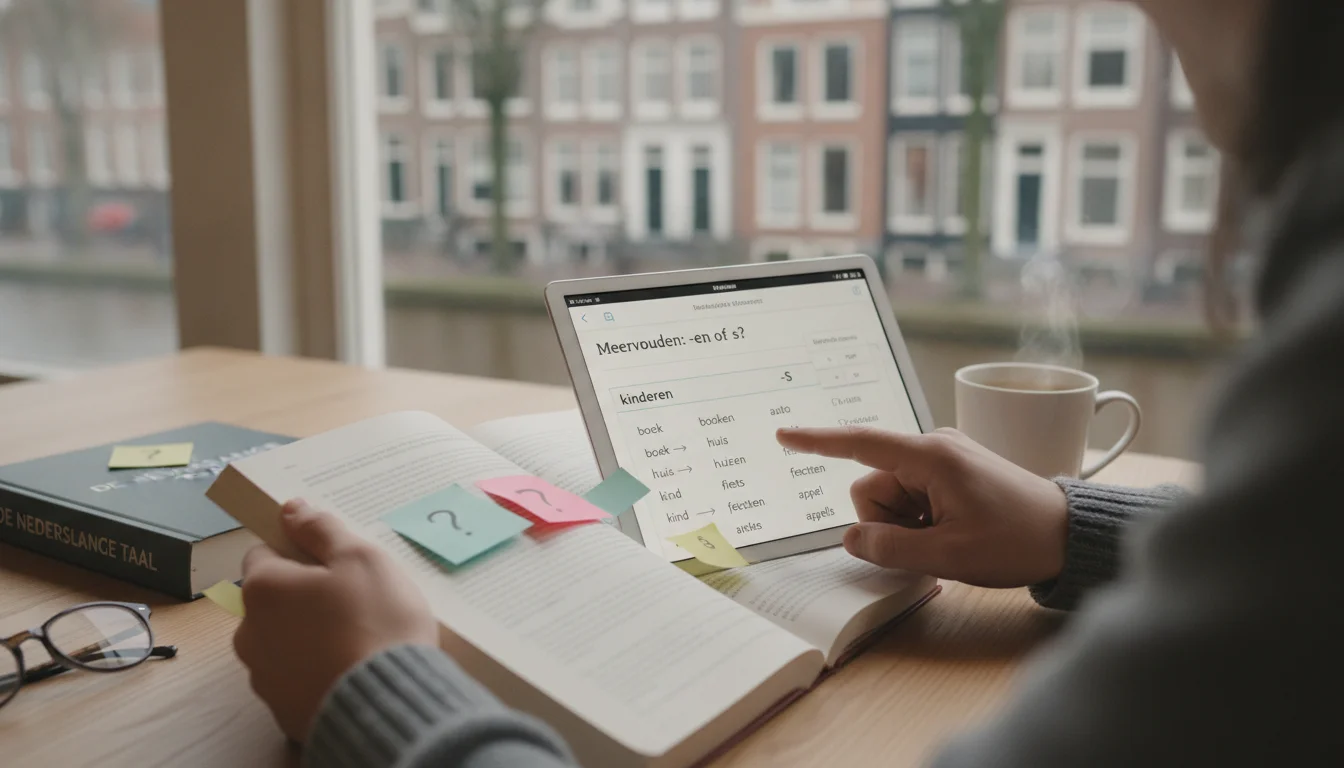
Mastering Dutch Plurals: When to Add -en or -s
Why Dutch Plurals Can Feel Like a Puzzle Have you ever stood at a bakery counter in Amsterdam, ready to order some delicious pastries, only to freeze...
Read more
Moving from an A2 elementary level to a B1 intermediate level in Dutch is one of the most exciting yet challenging milestones on your language-learning journey. At the A2 level, you have the survival tools: you can order a classic Dutch stroopwafel, ask for directions in Utrecht, and exchange basic pleasantries with your neighbors. However, transitioning to B1 means shifting from simple survival to active participation in Dutch society.
In 2026, reaching B1 fluency is more important than ever. The Dutch government continues to implement stricter integration guidelines under the civic integration act, making the B1 level the standard expectation for expats, high-skilled migrants, and long-term residents. Whether you are aiming to secure permanent residency through the Immigration and Naturalisation Service (IND), trying to advance your career in a Dutch-speaking office, or simply wanting to follow fast-paced discussions at the coffee machine, mastering B1 grammar is your key to success.
This comprehensive guide breaks down the essential intermediate Dutch grammar points you must master to bridge the gap between A2 and B1, complete with practical examples, structural analysis, and actionable learning strategies for 2026.
The single biggest grammatical indicator of a B1-level speaker is their ability to construct complex sentences using subclauses (bijzinnen). At the A2 level, you primarily rely on main clauses (hoofdzinnen), which follow a very straightforward word order: Subject + Finite Verb + Rest (e.g., 'Ik drink koffie omdat ik moe ben' is often simplified by beginners to two main clauses: 'Ik ben moe. Want ik drink koffie.').
In a Dutch subclause, the golden rule is that all verbs get kicked to the very end of the sentence. This requires a mental shift, as you have to hold the action verbs in your head until you reach the end of your thought.
A subclause is introduced by a subordinating conjunction such as omdat (because), als (if/when), dat (that), terwijl (while), or hoewel (although). Let's compare the word order:
When you have multiple verbs in a subclause (such as an auxiliary verb and an infinitive or past participle), they form a 'verb cluster' at the end of the sentence. For example: 'Ik denk dat hij gisteren heeft gewerkt' or 'Ik denk dat hij gisteren gewerkt heeft'. Both orders are grammatically correct in Dutch, but keeping them clustered at the very end is non-negotiable.
To truly master how these elements fit together, especially when adding context like time and manner, check out our deep dive into advanced Dutch word order and adverb placement.
To sound like a natural B1 speaker, you need to move beyond simple connectors like en (and), maar (but), and want (because). Intermediate Dutch demands logical transitions that show nuance, contrast, and cause-and-effect.
We can categorize intermediate connectors into three distinct groups based on how they impact sentence structure:
These connectors introduce a subclause, sending all verbs to the end of the clause.
These have zero impact on the word order of the following clause.
These connectors act as the first element of the sentence, which means they trigger inversion: the finite verb must immediately follow the connector, before the subject.
Understanding these distinctions is vital for passing the writing and speaking portions of the Inburgeringsexamen. You can master the subtle differences of these transition words by reading our guide on mastering connectors like daardoor, toch, and echter.
At the A2 level, you might have memorized a few common reflexive expressions like 'Ik was me' (I wash myself). At the B1 level, however, you will encounter a vast array of verbs that are inherently reflexive, meaning they cannot function without a reflexive pronoun. Mastering these is crucial for precise communication.
The reflexive pronoun changes depending on the subject of the sentence:
Word order with reflexive pronouns can get tricky, especially in subclauses or when inversion occurs. For example, in a subclause, the reflexive pronoun usually hugs the subject: 'Ik weet niet of hij zich goed voelt.' (I don't know if he feels well). To prevent common mistakes and build absolute confidence in using these structures, check out our comprehensive guide on reflexive verbs and the pronoun zich.
One of the most distinct differences between an A2 and a B1 speaker is how they handle the word er (there). While A2 speakers use it mostly to point out locations ('Er staat een boom' - There is a tree), B1 speakers use er to form pronominal adverbs.
In Dutch, you cannot easily combine a preposition with the pronoun het (it) or ze (them, referring to things). Instead, the preposition merges with er, daar, or hier.
Instead of saying 'Ik denk aan het' (which is grammatically incorrect), you replace het with er and merge it with the preposition:
Crucially, in natural Dutch speech, these pronominal adverbs are often split by other words in the sentence: 'Ik denk er al een hele tijd aan.' (I have been thinking about it for a long time). Learning to recognize and produce these split structures is a major milestone in your journey to B1 fluency.
At the B1 level, you will need to read Dutch news articles, understand formal emails, and comprehend official government communications. These texts frequently use the passive voice (de lijdende vorm) to focus on the action rather than the person performing it.
The passive voice in Dutch is formed using the auxiliary verbs worden (for present tense passive) or zijn (for past/perfect tense passive) combined with a past participle.
Use this to describe an ongoing process or action.
Use this to describe a completed action or state.
By learning to identify the passive voice, you will significantly improve your reading speed and comprehension, making those long B1 reading exams much less intimidating.
Studying grammar rules from a textbook is a good starting point, but rules alone won't make you fluent. To successfully transition from A2 to B1, you need to apply these structures in active, real-world contexts.
Transitioning from A2 to B1 Dutch is a transformative experience. It is the phase where you stop feeling like an outsider translating sentences word-for-word in your head and start feeling like an active participant in conversations. By mastering subclauses, intermediate connectors, reflexive verbs, pronominal adverbs, and the passive voice, you will build a rock-solid foundation for everyday fluency and professional success.
Are you ready to accelerate your journey to B1? Download the StroopTaal app today and experience how interactive dialogue games, real-time feedback, and personalized grammar training can transform your Dutch learning experience in 2026. Veel succes!
Share this article:
Why Dutch Plurals Can Feel Like a Puzzle Have you ever stood at a bakery counter in Amsterdam, ready to order some delicious pastries, only to freeze...
Read moreConquering the Dutch Verb System Learning Dutch is an exciting journey, but ask any expat, student, or language learner about their biggest hurdle,...
Read moreThe Puzzle of Dutch Word OrderHave you ever found yourself speaking or writing in Dutch, only to stop mid-sentence, suddenly unsure of where to place...
Read more