How to Pronounce the Dutch 'sch' Sound: Tips for English Speakers
If you have ever tried ordering a pastry in Amsterdam, asking for directions to Scheveningen, or simply greeting someone at school, chances are you...
Read more
If you have ever caught yourself saying "Ik ging naar kantoor gisteren" only to be gently corrected with "Ik ging gisteren naar kantoor", you have encountered one of the most infamous stumbling blocks in Dutch grammar: adverbial word order.
At the A1 and A2 levels, learners are primarily concerned with getting basic Subject-Verb-Object (SVO) structures right and making sure the verb lands in position two. But once you transition to the B1 level—where your sentences become more descriptive, complex, and nuanced—the order in which you arrange time, manner, and place becomes crucial for sounding like a natural Dutch speaker rather than a walking translation dictionary.
In this guide, we will break down the essential rules governing Dutch adverbs of time and place, explore how to combine them with objects and modal verbs, and look at common pitfalls to avoid on your journey to Dutch fluency.
English and Dutch approach adverbial placement from completely opposite perspectives. In English, speakers typically state Place before Time:
In standard Dutch grammar, the default sequence is strictly TMP: Tijd (Time) → Manier (Manner) → Plaats (Place).
Correct Dutch: Ik studeer elke middag (Time) in de bibliotheek (Place).
Incorrect literal translation: Ik studeer in de bibliotheek elke middag.
When you introduce Manner (how you do something) into the mix, it slots neatly into the middle:
Putting it all together into a standard main clause:
"Jan reist om acht uur (Time) met de trein (Manner) naar Utrecht (Place)."
In Dutch, you can begin a sentence with an adverb of time or place to highlight when or where an action took place. However, doing so triggers inversion, meaning the finite verb stays in position two, and the subject moves directly behind it.
Time adverbs are the most common sentence starters in conversational Dutch. They establish the temporal context immediately:
Starting with a place adverbial is also common when setting a physical scene or contrasting locations:
Notice that regardless of whether you start with Time or Place, the finite verb relentlessly occupies position two.
Once you add direct and indirect objects into a sentence with adverbs, many B1 learners feel overwhelmed. Fortunately, Dutch follows a clear hierarchy based on whether the object is a pronoun, a definite noun (with de, het, or a possessive pronoun), or an indefinite noun (with een or no article).
Personal pronouns (het, hem, haar, me, je, ons, hen) always precede adverbs of time and place:
"Ik heb hem (Pronoun Object) gisteren (Time) op het station (Place) gezien."
(I saw him yesterday at the station.)
Specific, definite objects usually appear before the time or place, or right after time:
"Zij brengt het boek (Definite Object) vandaag (Time) naar de bibliotheek (Place)."
or
"Zij brengt vandaag (Time) het boek (Definite Object) naar de bibliotheek (Place)."
Indefinite objects (non-specific things) gravitate toward the end of the clause, immediately before non-finite verbs (infinitives/participles):
"Wij gaan vanavond (Time) in het centrum (Place) een pizza (Indefinite Object) eten."
At B1 level, you frequently work with multi-verb constructions, such as auxiliary verbs in the perfect tense or modal verbs. Understanding where adverbs sit in relation to compound verbs is vital.
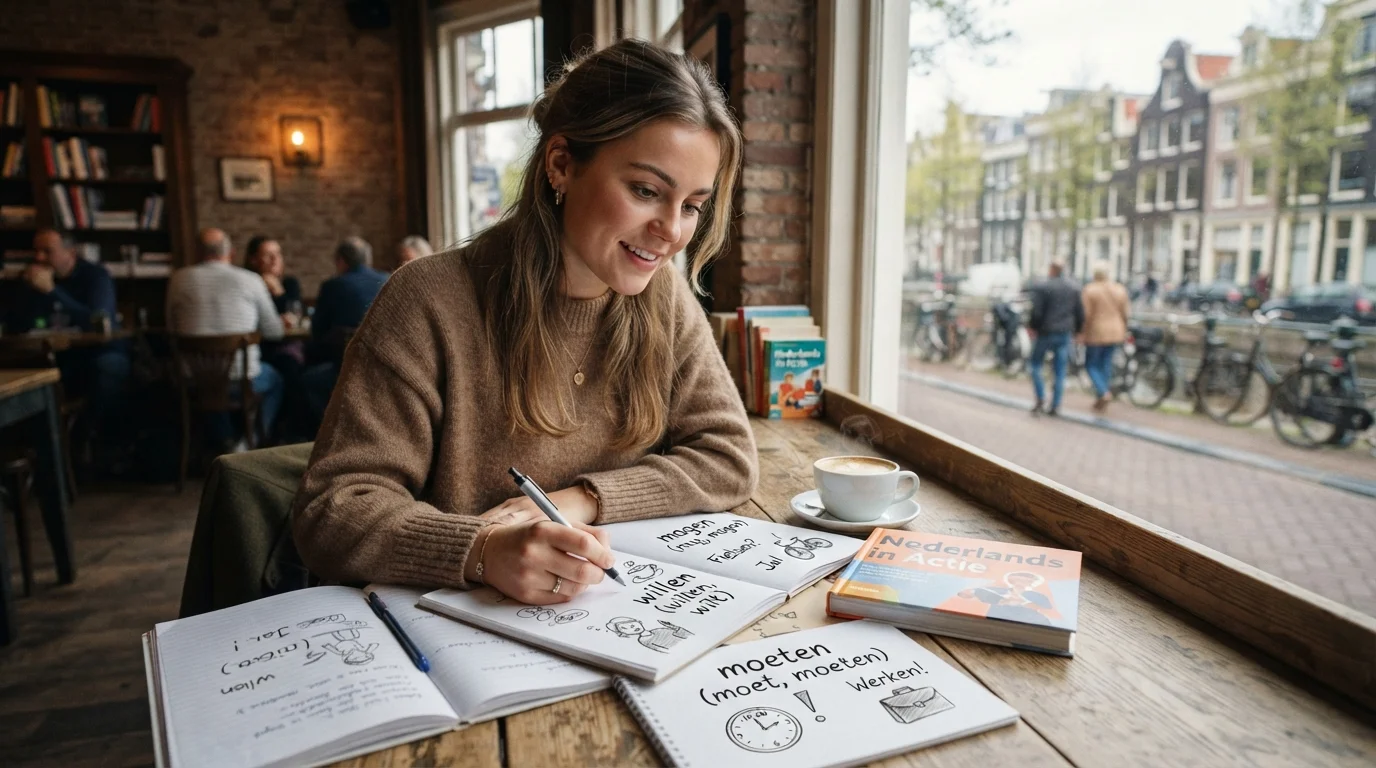
When mastering Dutch modal verbs like willen, mogen, and moeten, the conjugated modal stays in position two, while the action infinitive moves to the very end of the sentence. The TMP elements sit neatly in the middle field:
"Wij moeten (Modal) morgenochtend (Time) om negen uur (Time) naar het gemeentehuis (Place) gaan (Infinitive)."
In subordinate clauses introduced by conjunctions such as omdat (because), toen (when), or als (if), all verbs are sent to the end of the clause. Even in this SOV (Subject-Object-Verb) structure, the internal TMP sequence remains unchanged:
"Ik kon niet komen, omdat ik gisteren (Time) heel snel (Manner) naar de dokter (Place) moest gaan."
Conversational Dutch is packed with small words like toch, even, eens, and maar that convey tone, politeness, or subtle intent. Positioning these words correctly alongside your time and place adverbs makes your Dutch sound remarkably natural.
As a rule of thumb, modal particles appear early in the middle field, often directly before or right after the time adverbial. For example, when integrating nuanced modal particles like toch:
"Je gaat toch morgen (Time) naar kantoor (Place)?" (You are going to the office tomorrow, aren't you?)
| Element | Function / Question | Example |
|---|---|---|
| 1. Subject / Topic | Wie? / Wat? (or fronted adverb) | Lisa |
| 2. Finite Verb | Conjugated verb in position 2 | fietst |
| 3. Time (Tijd) | Wanneer? Hoe vaak? | elke ochtend |
| 4. Manner (Manier) | Hoe? Met wie? | met veel plezier |
| 5. Place (Plaats) | Waar? Waarheen? | naar haar werk |
| 6. End Verbs | Infinitives / Participles | (geen) |
Memorizing rules like TMP is a great starting point, but speaking spontaneously without pausing to calculate your sentence structure requires real-time practice. Whether you are studying at home or learning Dutch during your daily commute, consistent application builds grammatical instinct.
This is where StroopTaal accelerates your progress. Through AI-powered conversational scenarios and instant pronunciation training, StroopTaal helps you practice natural sentence patterns in realistic dialogues. The app's structured grammar modules from A0 to C1 allow you to drill word order rules, while spaced-repetition reviews bring them back until placing your time, manner, and place adverbs feels natural.
Mastering Dutch word order with adverbs of time and place is a defining milestone on your path to B1 fluency and passing your integration exams. By keeping the TMP (Tijd - Manier - Plaats) formula in mind, respecting inversion rules when fronting adverbs, and paying attention to object types, your Dutch sentences will immediately sound cleaner, clearer, and much more native.
Take time today to construct five sentences about your daily routine using the Time → Manner → Place order. With regular practice and intuitive feedback, you will be composing complex Dutch sentences effortlessly!
Share this article:
If you have ever tried ordering a pastry in Amsterdam, asking for directions to Scheveningen, or simply greeting someone at school, chances are you...
Read moreIf you have ever spent five minutes in the Netherlands, walked into a cozy bakery, or listened to Dutch colleagues chatting over lunch, you have...
Read moreIf you have ever tried to navigate a daily conversation in the Netherlands, you quickly realize that expressing your wishes, permissions, and...
Read more