
Common Dutch Errors: Stop Translating Literally from English
Are You Making These Common Dutch Errors? The Perils of Literal Translation You're standing in a bustling Albert Heijn, determined to practice your...
Read more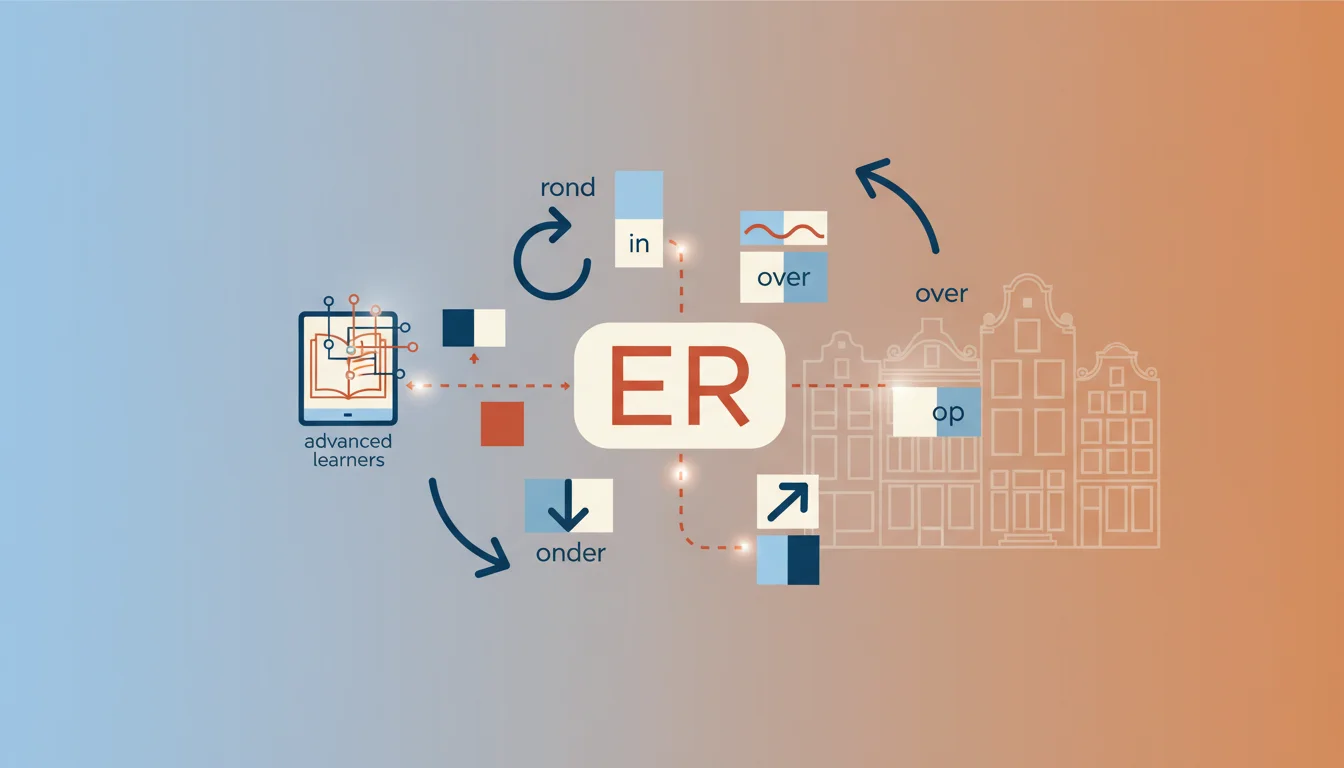
If you’ve been learning Dutch for a while, you've undoubtedly encountered it. A tiny, two-letter word that seems to appear everywhere, often in the most confusing places: er. For many advanced learners, mastering 'er' feels like the final boss of Dutch grammar. It can be a locational adverb, an indefinite subject, or a part of a fixed expression. But its most challenging role is arguably its partnership with prepositions.
You see a sentence like, "Ik denk erover na," and wonder, "Where did that come from? Why not 'Ik denk over het na'?" If this sounds familiar, you're in the right place. This guide will demystify the use of 'er' with prepositions, breaking down the rules, the exceptions, and the logic behind it all. By the end, you'll not only understand this complex structure but also be able to use it with confidence.
Before we dive into the deep end, let's establish the core concept: the pronominal adverb (voornaamwoordelijk bijwoord). This is the grammatical term for the combination of 'er' (or 'hier', 'daar', 'waar') and a preposition. In Dutch, when you have a preposition that refers to an inanimate object or a concept (i.e., 'it' or 'that'), you don't say `preposition + het/dat`. Instead, you merge them into a pronominal adverb.
The golden rule is simple:
'er' + preposition = preposition + 'it'/'that'
Let's look at it in action:
Notice that for prepositions starting with a vowel, an '-r-' is inserted for smoother pronunciation: er-in, er-op, er-uit, er-over.
Example Sentences:
Here's where things get interesting for advanced learners. In many sentences, 'er' and its prepositional partner are not side-by-side. They get split up by other words. This is one of the biggest hurdles to overcome, but it follows a consistent logic based on Dutch sentence structure.
In a main clause (hoofdzin), 'er' tends to stay close to the conjugated verb, while the preposition is kicked to the end of the clause, often just before the other verbs.
What can come between 'er' and the preposition? Almost anything! Adverbs of time (al de hele dag), manner, direct objects, and negation words are common intruders.
For example, mastering the rules of Dutch negation is crucial here. Look how 'niet' splits the pair:
In a subclause (bijzin), the same principle applies, but the word order is different. 'Er' still comes early, and the preposition clusters with the verbs at the very end.
Getting familiar with the most common pronominal adverbs will dramatically improve your fluency. Here’s a list to get you started. Try to create your own sentences with them!
This is also where more complex verb tenses come into play. For instance, with the perfect tense, the preposition will come right before the past participle. Understanding how to form Dutch verbs correctly is essential. For example: Ik heb er lang over nagedacht. (I have thought about it for a long time.)
Understanding the grammar is the first step, but true mastery comes from practice. Here’s how you can internalize the use of 'er' with prepositions:
Mastering 'er' with prepositions is a significant milestone in your journey to Dutch fluency. It's a concept that separates intermediate speakers from advanced ones. The key is to remember the two fundamental rules: the formation of pronominal adverbs (er + preposition) and the tendency for these two parts to split in a sentence.
Don't be afraid to make mistakes. Every time you try to form a sentence with 'erop' or 'ermee', you're building the neural pathways needed to make it second nature. Keep practicing, keep listening, and keep speaking.
Ready to put this knowledge into practice? Download the StroopTaal app and start having intelligent, interactive conversations today. Our AI-powered lessons will help you master 'er' and other tricky grammar points through real-world scenarios. Succes!
Share this article:
Are You Making These Common Dutch Errors? The Perils of Literal Translation You're standing in a bustling Albert Heijn, determined to practice your...
Read moreIntroduction: The Secret to Dutch Past Tense If you are learning Dutch, you have likely encountered the infamous 't kofschip rule. For many expats,...
Read moreIntroduction: The Secret to Sounding Like a Native Dutch Speaker If you have been learning Dutch for a while, you have probably realized that...
Read more