Mastering Dutch Adjectives: When to Add the 'E' (2026 Guide)
Is it 'een groot huis' or 'een grote huis'? Your Guide to Dutch Adjective Endings You’re standing in front of a beautiful Dutch canal house. You...
Read more
You're standing in a bustling Albert Heijn, determined to practice your Dutch. You want to ask, "Can you help me?" Your brain quickly translates: Can is 'kan', you is 'jij', and help me is 'help mij'. You confidently ask, "Kan jij help mij?" The employee understands, but you can tell from their slight hesitation that something was off. The correct phrase is "Kan je mij helpen?"
If this scenario feels familiar, you're not alone. For English speakers, one of the biggest hurdles in learning Dutch is the temptation to translate word-for-word. While English and Dutch are Germanic cousins, they've walked different paths for centuries. Thinking in English and speaking in Dutch is like trying to fit a square peg into a round hole—it just doesn't work.
This comprehensive guide will explore the most common pitfalls of literal translation and provide you with the tools and mindset to start thinking, and therefore speaking, like a true Dutchie.
Languages are more than just collections of words; they are intricate systems that reflect a culture's way of thinking. Dutch grammar, sentence structure, and idiomatic expressions have their own internal logic. Simply swapping English words for their Dutch equivalents ignores this underlying framework, leading to sentences that are clunky, confusing, or just plain wrong.
To truly master Dutch, you need to shift your perspective. Instead of asking "How do I say this English sentence in Dutch?", start asking "How would a Dutch person express this idea?" This shift is the first and most crucial step toward fluency.
English word order is relatively fixed: Subject-Verb-Object (SVO). "I buy bread today." Dutch, however, is a V2 language, meaning the conjugated verb must always be the second element in a main clause. This trips up almost every learner.
In a simple sentence, Dutch looks similar to English: Ik koop brood. (Subject-Verb-Object). But if you start the sentence with anything other than the subject, the verb still holds its second position, forcing the subject to move.
This inversion is non-negotiable in Dutch and is an immediate sign of a fluent speaker. Getting this right will instantly make you sound more natural.
As if V2 wasn't enough, Dutch sends verbs to the end of the sentence in subordinate clauses (clauses that can't stand alone, often starting with conjunctions like 'omdat', 'dat', or 'terwijl').
Notice how 'leer' (learn) is kicked to the very end of the clause. This is one of the most significant structural differences from English. Understanding why certain conjunctions trigger this word order is key, as explained in our guide to using Dutch conjunctions like 'omdat' and 'want'.
Prepositions are tricky in any language, but the English-to-Dutch mapping is particularly inconsistent. You can't assume that 'for' always translates to 'voor' or 'on' always translates to 'op'.
The only way to master these is to learn them as fixed combinations or 'collocations'. Don't learn the word 'wachten'; learn the chunk 'wachten op'.
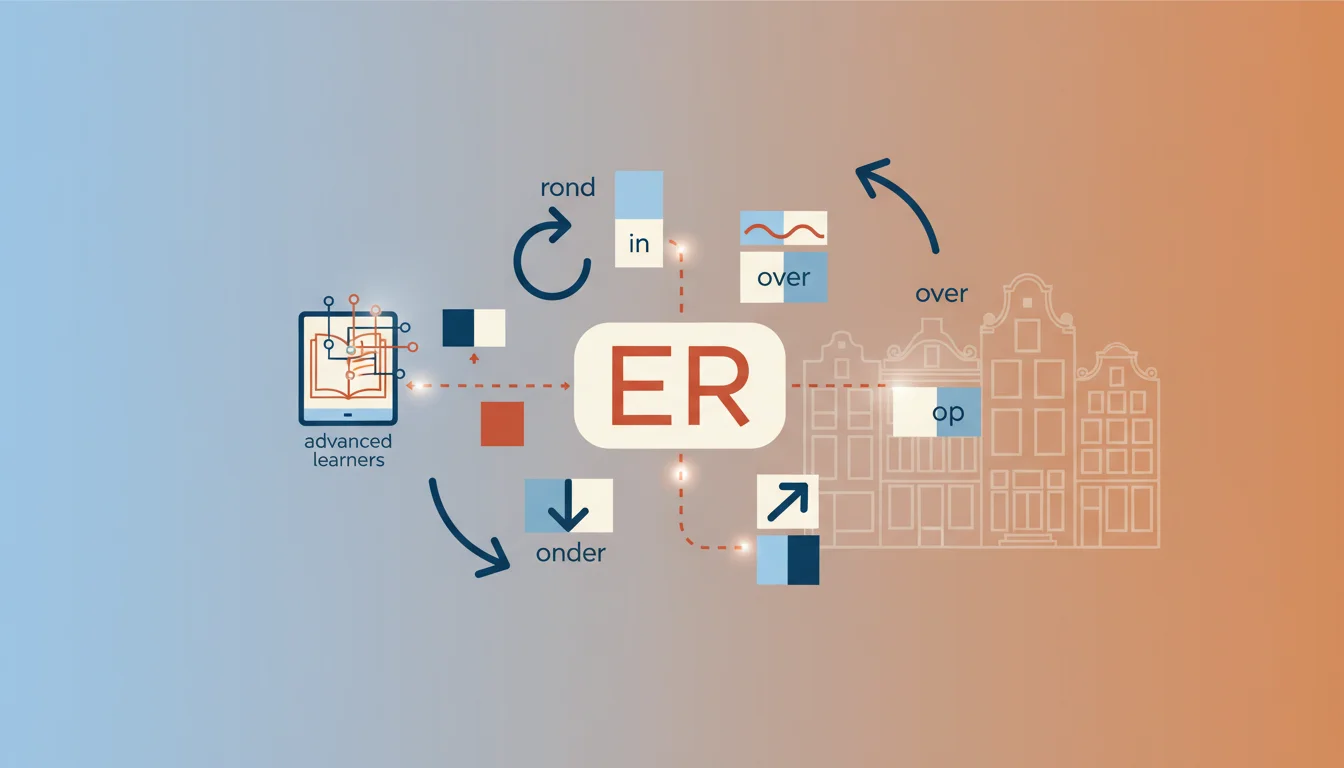
This gets even more complex when you introduce 'er', a small word with a huge impact. It often combines with prepositions to replace a noun. This concept can be challenging, but mastering it is a sign of advanced proficiency. For a deeper dive, check out our complete guide to using 'er' with prepositions.
Sometimes, a Dutch word looks and sounds just like an English word, but its meaning is completely different. These are called 'false friends', and they can lead to some embarrassing mix-ups.
Beyond single words, idiomatic expressions almost never translate directly. While you might be 'over the moon' in English, a Dutch person is 'in de zevende hemel' (in the seventh heaven). It never 'rains cats and dogs'; instead, 'het regent pijpenstelen' (it's raining pipe stems). Trying to translate these literally will only get you confused looks. To avoid these common slip-ups, it's worth studying the most common Dutch false friends that confuse English speakers.
Here's a concept that truly requires you to 'think in Dutch'. In English, an object simply 'is' somewhere: "The cup is on the table," "The book is on the shelf," "The key is in the lock."
Dutch is far more specific. You must use a verb that describes the object's physical position or state.
This is a fundamental aspect of the language that direct translation completely misses. For more examples, our guide to mastering zitten, staan, and liggen can help you internalize this Dutch way of seeing the world.
Okay, so literal translation is out. What's the solution? The goal is to build a direct pathway in your brain from a concept to its Dutch expression, without the English middleman. Here's how:
Letting go of English as a crutch is the single most impactful change you can make in your Dutch learning journey. By focusing on Dutch word order, learning prepositions as fixed pairs, being wary of false friends, and understanding core concepts like verbs of position, you'll move beyond stilted translations and into the realm of natural, confident communication.
It's a process that takes time and practice, but the reward—being able to truly express yourself and connect with people in their native language—is immeasurable.
Ready to put this into practice? Download the StroopTaal app and start having smarter conversations today. Our personalized learning plans and interactive exercises are designed to help you break the translation habit and start thinking in Dutch.
Share this article:
Is it 'een groot huis' or 'een grote huis'? Your Guide to Dutch Adjective Endings You’re standing in front of a beautiful Dutch canal house. You...
Read moreThe Little Word That Changes Everything: Your Guide to 'Er' with Prepositions If you’ve been learning Dutch for a while, you've undoubtedly...
Read moreIntroduction: The Secret to Dutch Past Tense If you are learning Dutch, you have likely encountered the infamous 't kofschip rule. For many expats,...
Read more