Best Dutch Language Schools in Amsterdam: 2026 Guide

Best Dutch Language Schools in Amsterdam: 2026 Guide

So, You're Learning Dutch in Amsterdam? Let's Find Your Perfect School

Welcome to Amsterdam! You've navigated the canals, tried your first stroopwafel, and skillfully dodged a few cyclists. Now comes the next big adventure: learning Dutch. While the locals' English is famously excellent, speaking the language is your key to unlocking a deeper connection with the city, the culture, and your new life here. But with so many options, choosing from the best Dutch language schools in Amsterdam can feel like navigating the ring road during rush hour.

Don't worry, we're here to be your guide. Whether you're a complete beginner aiming for conversational fluency, an expat preparing for the inburgeringsexamen (civic integration exam), or a professional looking to polish your skills, there's a school in Amsterdam for you. This comprehensive 2026 guide will break down the top institutions, comparing their teaching styles, costs, and what type of learner they suit best.

Why an In-Person Dutch School Still Matters in the Digital Age

In a world of language apps and online tutors, you might wonder if a traditional classroom is still relevant. The answer is a resounding ja! While digital tools are fantastic for reinforcement, an in-person school in Amsterdam offers unique advantages:

  • Structure and Accountability: A fixed schedule and the presence of a teacher keep you on track and motivated, especially on those rainy Amsterdam days.
  • Immediate Feedback: Have a question about that tricky Dutch word order? You can ask a teacher and get an instant, nuanced explanation. This is crucial for building a solid foundation.
  • Social Connection: Learning with others is fun! You'll meet fellow expats and newcomers, practice speaking in a safe environment, and build a community. It’s a language course and a social club rolled into one.
  • Cultural Immersion: Teachers don't just teach grammar; they share cultural insights, explain idioms, and give you a real feel for life in the Netherlands.

Key Factors to Consider When Choosing Your School

Before you sign up, take a moment to consider what you truly need. The 'best' school is the one that fits your goals, learning style, and budget. Here’s what to look for:

Teaching Methodology

Schools typically follow a communicative approach, focusing on using the language in real-life situations. However, some are more grammar-intensive, while others, like Koentact, are famous for taking learning out onto the streets. Think about how you learn best. Do you need structured grammar rules, or do you thrive on interactive role-playing?

Class Size and Intensity

Do you prefer the personalized attention of a small group (6-8 students) or the dynamic energy of a larger class (12-15 students)? Also, consider the pace. An intensive course might meet every day for several hours, getting you to the next level quickly. An evening course, meeting twice a week, offers more flexibility if you're working full-time.

Accreditation and Certification

If your goal is to pass an official exam like the NT2 Staatsexamen or the Inburgeringsexamen, make sure the school is qualified to prepare you. Many schools are recognized by organizations like Blik op Werk, which is often a requirement if you plan to use a loan from DUO (Dienst Uitvoering Onderwijs) to pay for your course. For more information on integration requirements, the Dutch government's official website is an excellent resource.

Cost and Location

Prices can vary dramatically. A course at a community-run institution might cost a few hundred euros, while an intensive program at a university can run into the thousands. Always check what's included—are books and materials extra? Finally, consider the commute. Choosing a school that's easy to get to will make it much easier to stay consistent.

The Best Dutch Language Schools in Amsterdam: 2026 Comparison

We've reviewed some of the most popular and reputable Dutch schools in the capital. Here’s our breakdown for 2026.

1. UvA Talen (University of Amsterdam)

  • Best for: Academic, fast-paced, and serious learners.
  • Methodology: A highly structured, communicative approach with a strong emphasis on accuracy. The pace is famously fast, designed to get you to the next level efficiently.
  • Course Offerings: Intensive day courses (4-5 days a week), evening courses (twice a week), and online options. They offer a full trajectory from absolute beginner (A1) to near-native fluency (C1).
  • Price Range: €€€€ (Higher end)
  • Pros: University-affiliated reputation, clear learning path, highly qualified teachers, excellent for NT2 exam preparation.
  • Cons: Demanding workload, larger class sizes, can be less focused on social 'gezelligheid'.

2. Koentact

  • Best for: Social learners who want to practice in the real world.
  • Methodology: Unique and immersive. Half the lesson is in the classroom, and the other half is 'in the wild'—practicing at a local market, in a café, or at a museum. The focus is on building confidence and overcoming the fear of speaking.
  • Course Offerings: A variety of group courses, conversation classes, and private lessons. They focus heavily on A1-B1 levels.
  • Price Range: €€€ (Mid-to-high range)
  • Pros: Extremely practical, fun and engaging, great for meeting new people and breaking the 'expat bubble'.
  • Cons: Less emphasis on deep grammar might not suit learners who need a lot of structure.

3. TopTaal

  • Best for: Learners focused on passing the Inburgering or NT2 exams.
  • Methodology: Highly goal-oriented and practical, with a curriculum specifically designed to meet the requirements of official state exams. They are a certified Blik op Werk provider, making them a top choice for those using a DUO loan.
  • Course Offerings: Specialised tracks for Inburgering, Staatsexamen NT2 Program I & II, and Dutch for Professionals. They offer both intensive and part-time options. Nailing the specific vocabulary for these exams is crucial, which is a key reason many students use apps for extra practice.
  • Price Range: €€ (Often covered by DUO loans)
  • Pros: Direct path to certification, experienced with official requirements, eligible for government funding.
  • Cons: The learning environment can feel more functional and less focused on broader cultural immersion compared to other schools.

4. Volksuniversiteit Amsterdam

  • Best for: Budget-conscious and casual learners.
  • Methodology: A more traditional, community-focused classroom setting. The pace is generally relaxed, making it a low-pressure environment to start your language journey.
  • Course Offerings: A wide array of Dutch courses at all levels, typically held once or twice a week in the evenings.
  • Price Range: € (Very affordable)
  • Pros: Excellent value for money, relaxed atmosphere, convenient for those with busy schedules.
  • Cons: Classes can be quite large, and the pace might be too slow for ambitious learners.

5. Dutch Courses Amsterdam

  • Best for: Learners who want small groups and a solid grip on grammar and word order, with plenty of speaking practice.
  • Methodology: Every course is split into a grammar part and a conversation part, each with its own specialised teacher. You learn a new grammar topic and put it to use the same day in the conversation lesson. The school's own study materials focus on everyday conversation and correct word order, one of the hardest parts of Dutch for most learners.
  • Course Offerings: A two-week intensive day course (Monday to Friday, 35 hours per level), a seven-week evening course, an afternoon semi-intensive course, online evening classes via Zoom, and private or duo lessons. Levels run from A0 (complete beginner) to B2, plus conversation classes at B2 and C1, with orientation towards the NT2 and IBEX exams.
  • Price Range: €€ (€675 per level at the school, €600 online, study materials included)
  • Pros: A maximum of 8 students per group, two specialised teachers per course, more than 17 years of teaching experience, and an average rating of 4.9/5 across more than 400 reviews, according to the school.
  • Cons: There is one location, in Amsterdam-West rather than the city centre, and with only 8 places per group, popular start dates can fill up quickly.

Supercharge Your Learning: Combine Your Course with Digital Tools

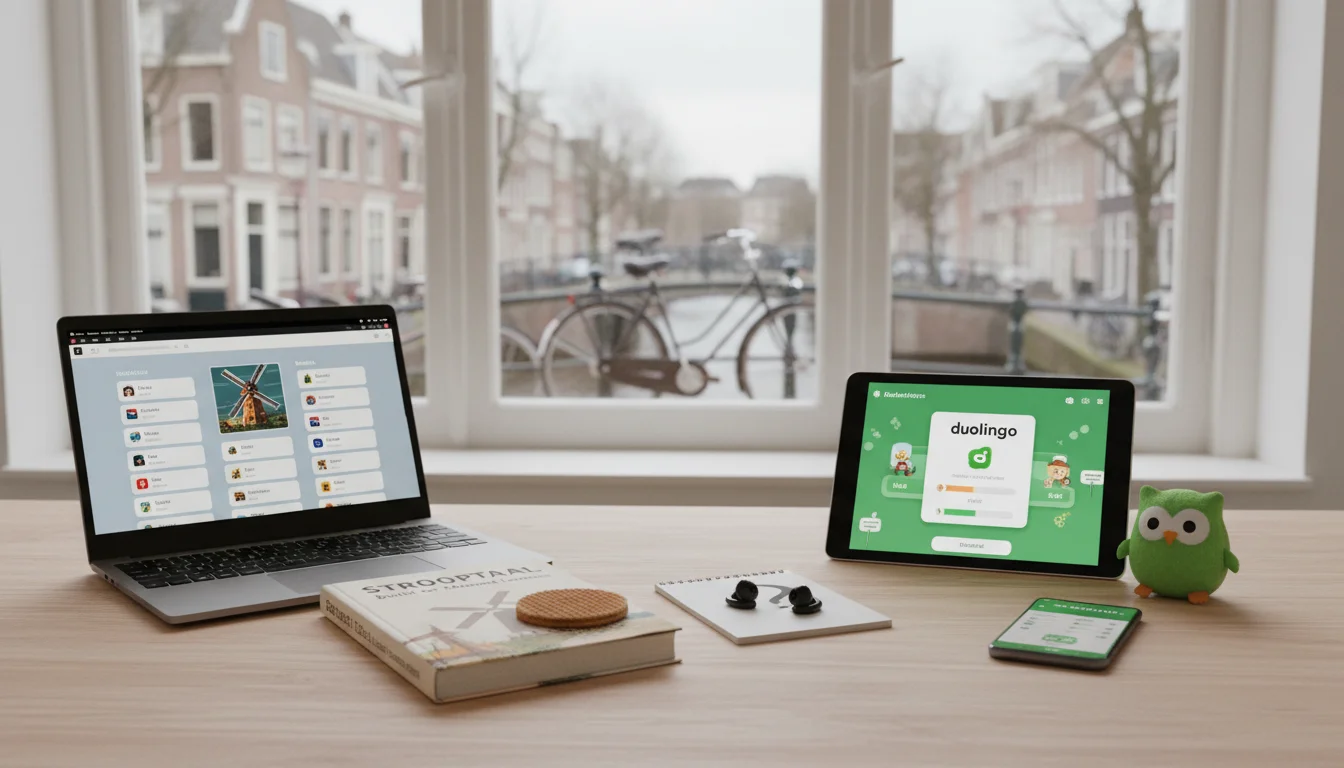
Your progress doesn't stop when you leave the classroom. The most successful language learners create a daily habit of practice. This is where a smart language app becomes your secret weapon. Supplementing your course with a tool like StroopTaal can dramatically accelerate your progress.

Use it to pre-learn vocabulary before a class, review grammar concepts afterwards with AI-powered personalized plans, or practice what you've learned through interactive dialogue games. The real game-changer is being able to practice speaking anytime. Instead of waiting for your next class, you can have a conversation with an AI tutor and get instant pronunciation feedback, which is something many learners struggle with. For more on this, check out our review of the best AI tools to perfect your Dutch accent.

Beyond the Classroom: Living the Language in Amsterdam

Learning Dutch is about more than just textbooks and tests. It's about integrating into daily life. Here are a few tips to practice your Dutch outside of school:

  • Visit a market: Go to the Albert Cuypmarkt or Noordermarkt and try ordering your cheese, bread, or herring in Dutch. Start small with 'Een stuk kaas, alstublieft'.
  • Join a 'vereniging': Sign up for a sports club or a creative workshop. It's a fantastic way to meet Dutch people who share your interests.
  • Watch Dutch television: Start with children's shows like 'Buurman en Buurman' or use subtitles on popular shows on NPO Start.
  • Speak, even if it's not perfect: Dutch people will often switch to English to be helpful. Politely say, 'Sorry, ik wil graag Nederlands oefenen' (Sorry, I'd like to practice Dutch). They will usually be happy to oblige! This is much easier once you have a foundation of essential Dutch words for daily interactions.

Conclusion: Your Dutch Journey Starts Now

Choosing the right Dutch language school in Amsterdam is a critical first step on your path to fluency. Whether you need the academic rigor of UvA Talen, the real-world immersion of Koentact, the exam-focused approach of TopTaal, or the budget-friendly classes at the Volksuniversiteit, there is an option tailored to your needs.

Define your goals, consider your learning style, and don't be afraid to ask for a trial lesson if possible. Most importantly, combine your classroom learning with consistent daily practice. By immersing yourself in the language both in and out of school, you won't just be learning Dutch—you'll be truly making Amsterdam your home.

Ready to build a powerful daily learning habit? Download the StroopTaal app and see how our AI-powered features can complement your school lessons and accelerate your journey to Dutch fluency!

Frequently Asked Questions

How much does a Dutch course in Amsterdam cost?
Prices vary widely, from around €250 for a budget-friendly course at a community center to over €1000 for an intensive university-level program. Always check for early-bird discounts and whether the course materials are included in the price.
How long does it take to become fluent in Dutch?
Fluency is a long journey, but you can reach a conversational level (B1) in 6-12 months with consistent effort, including an intensive course and daily practice. Factors like your native language and time commitment play a significant role.
Do I need to learn Dutch to live in Amsterdam?
While you can get by with English, learning Dutch is essential for true integration, understanding the culture, and navigating bureaucracy. It opens up more job opportunities and helps you connect with the local community on a much deeper level.