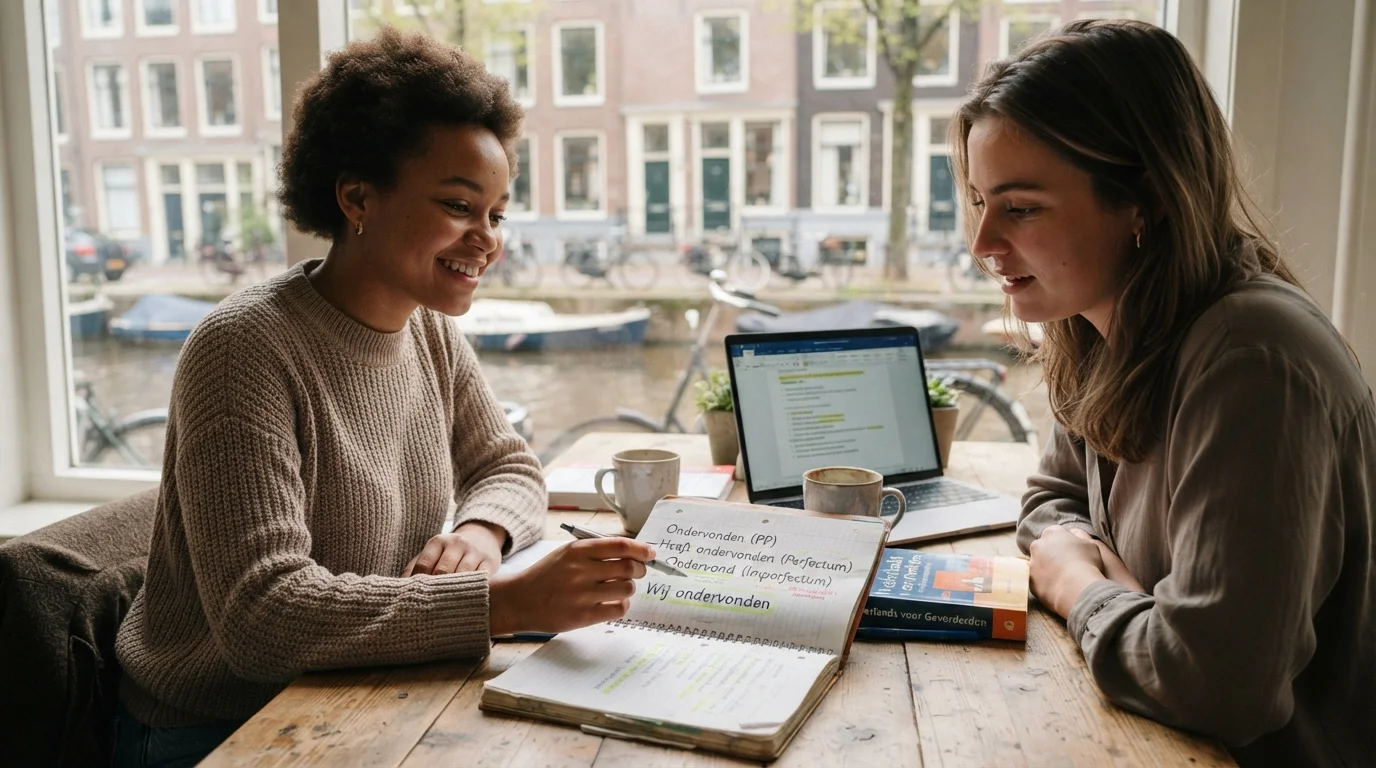
Dutch Imperfect Tense: Ondervond vs Heb Ondervonden
Have you ever wanted to describe a difficult experience in Dutch, only to hesitate between ik ondervond and ik heb ondervonden? Both forms come from...
Read more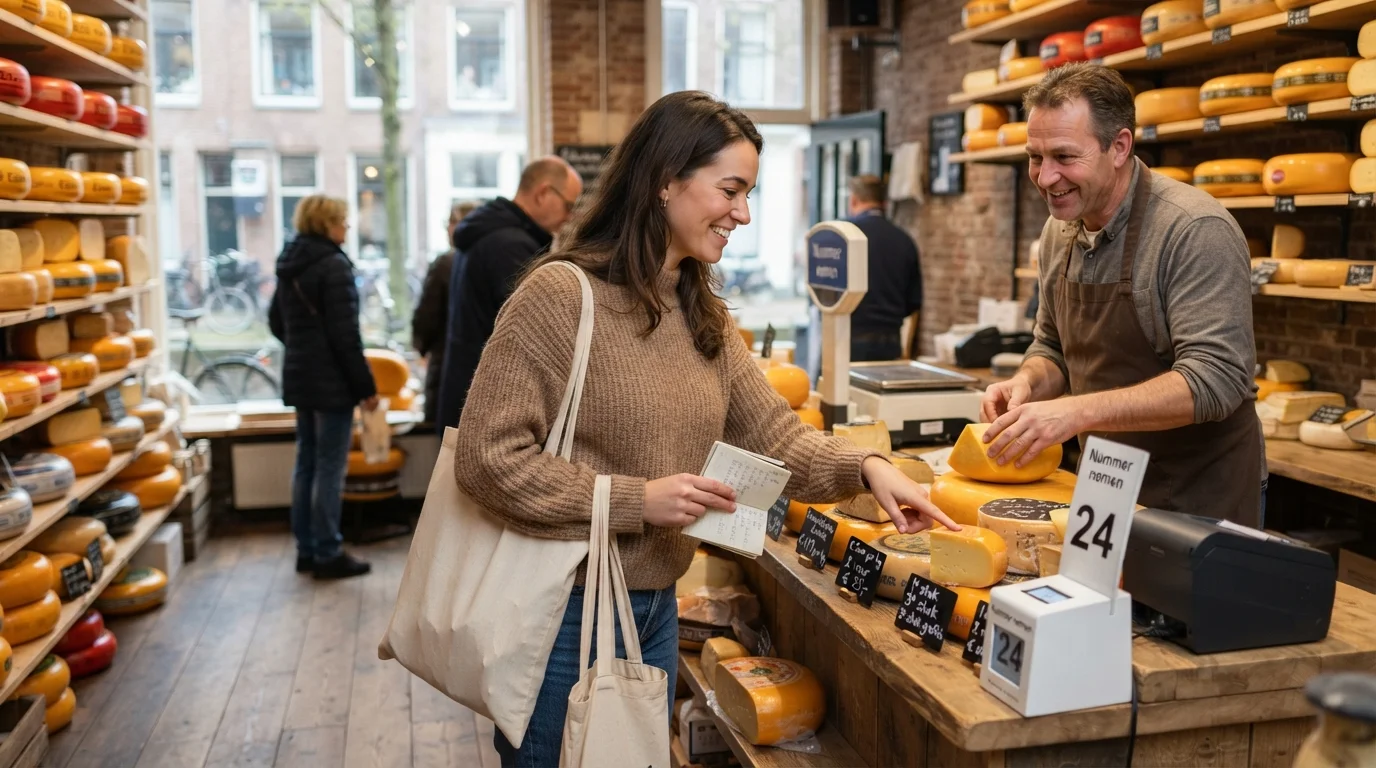
Picture this: You are standing in line at a bustling weekly market in Utrecht or navigating the checkout at your local Albert Heijn. The market vendor shouts, "Wie is de volgende?" (Who is next?), and someone answers, "Ik ben de derde!" (I'm third!). Then the vendor weighs your Gouda cheese and rattles off, "Dat is dan vierentwintig vijfennegentig, alstublieft."
If your brain immediately freezes trying to decode backward numbers while fumbling for your PIN card, you are definitely not alone. Dutch numbers have a notorious quirk: from number 21 to 99, the Dutch say the units before the tens (literally saying "four-and-twenty" instead of "twenty-four").
Whether you are ordering two hundred grams of cheese, hunting for 1+1 gratis deals, or preparing for your inburgering integration exam, mastering cardinal numbers (one, two, three) and ordinal numbers (first, second, third) is an absolute superpower. In this comprehensive guide, we will break down both systems step-by-step and show you exactly how to use them in everyday Dutch shopping situations.
Cardinal numbers (hoofdtelwoorden) answer the question "Hoeveel?" (How many?). They are the basic counting numbers you use to express quantities, prices, weights, and telephone numbers.
The numbers from 0 to 12 are unique words that must be memorized individually. From 13 to 19, numbers follow the suffix -tien (ten), similar to the English "-teen".
Tens in Dutch end in -tig (equivalent to "-ty" in English):
Here is where English speakers usually stumble. In Dutch, for any two-digit number over twenty containing units and tens, you say the units first, followed by en (and), and finally the tens. All of this is written as a single compound word.
For example:
Spelling Tip (Trema): When the unit ends in a vowel (such as twee or drie), you place a diaeresis (trema) over the 'e' of en to maintain proper syllable pronunciation: tweeëntwintig (22), drieënveertig (43).
When you move past 100, the structure returns to the standard larger-to-smaller order, but the two-digit ending keeps its reversed structure:
For a detailed breakdown of how Dutch numerical morphology operates across all Germanic languages, you can explore the Dutch numeral system on Wikipedia.
Ordinal numbers (rangtelwoorden) indicate sequence, rank, position, or floor levels. They answer the question "De hoeveelste?" (Which one in order?).
The rules for forming ordinal numbers in Dutch are straightforward and depend on the ending of the cardinal number:
Notice that in written abbreviations, the Dutch simply append an 'e' to the digit: 1e (or 1ste), 2e (or 2de), 3e, 20e.
Now that you know the rules, let's put these numbers to work in real-world retail settings. Grocery shopping in the Netherlands comes with its own set of cultural nuances and specific vocabulary.
When hearing prices spoken out loud, cashiers often omit the word euro if the amount includes cents, or they place euro between the main amount and the cents:
The 5-Cent Rounding Rule: Since 2004, the Netherlands rounds cash payments to the nearest 5 cents (afronden). If your total is € 10,02, you pay € 10,00 in cash; if it is € 10,04, you pay € 10,05. However, if you pay by debit card (pinnen), you pay the exact amount down to the single cent.
At traditional market stalls, bakeries, and butcher counters, ingredients are ordered using specific metrics. You will frequently hear informal and diminutive units of measurement. In Dutch culture, food items frequently take diminutive suffixes; to understand why a portion becomes small and endearing, check out our guide on understanding Dutch diminutives.
Common shopping weights include:
Dutch supermarkets like Albert Heijn, Jumbo, and Plus love promotional sales (aanbiedingen or korting). Ordinal and cardinal numbers appear on banners throughout the store:
Knowing these phrases helps you spot actual savings versus marketing tricks during your weekly shop.
Even when you understand the grammar, spoken Dutch numbers can trip you up in noisy retail environments. Here are the three most common pronunciation challenges to listen for:
In standard Dutch, the number 7 is zeven. However, in stores, train stations, and phone calls, you will constantly hear native speakers say zeuven (rhyming with the Dutch vowel in leuk). This is deliberate! The words zeven (7) and negen (9) sound remarkably similar in loud markets or over bad intercoms. Saying zeuven eliminates confusion.
Just like English speakers confuse "fourteen" and "forty", learners often mix up numbers ending in -tien with those ending in -tig:
If you want to train your ear and polish your spoken accuracy, using the StroopTaal app provides instant pronunciation training with real-time feedback, helping you distinguish subtle consonant and vowel differences before you speak to vendors.
When you are describing how much of something you want or modifying quantities, you will often use adverbs. If you want to refine how you qualify descriptions in sentences, make sure to review our lesson on heel vs zeer vs erg as well as master natural sentence structure via our guide on Dutch word order with adverbs.
Let's look at two practical dialogues illustrating both cardinal and ordinal numbers in everyday shopping conversations.
Klant (Customer): Goedemorgen! Mag ik driehonderd gram belegen kaas?
Koopman (Vendor): Zeker. Wilt u het aan één stuk of in plakjes?
Klant: In plakjes, alstublieft. En mag ik ook twee ons van die Franse brie?
Koopman: Alstublieft, dat is dan samen acht euro vijfenzeventig (€ 8,75).
Klant: Kan ik pinnen?
Koopman: Ja hoor, graag zelfs!
Klant: Pardon, op de hoeveelste verdieping vind ik de kookpannen?
Medewerker: Die staan op de tweede verdieping, naast de liften.
Klant: Dank u wel! En waar kan ik een nummertje trekken voor de klantenservice?
Medewerker: De automaat staat bij de eerste kassa. U bent dan waarschijnlijk de vierde wachtende.
Keep this handy reference chart in mind when preparing your next shopping list:
| Digit | Cardinal (Hoofdtelwoord) | Ordinal (Rangtelwoord) | Shopping Context Example |
|---|---|---|---|
| 1 | één | eerste | De eerste klant krijgt korting. |
| 2 | twee | tweede | Het tweede artikel is gratis. |
| 3 | drie | derde | Drie broden voor vijf euro. |
| 8 | acht | achtste | Kassa nummer acht is geopend. |
| 20 | twintig | twintigste | Twintig procent korting. |
| 25 | vijfentwintig | vijfentwintigste | Dat kost vijfentwintig euro. |
Reading the rules for Dutch numbers is easy, but processing them at high speed when a Dutch cashier looks at you requires real practice. To build confidence, try practicing shopping dialogues in an interactive setting.
With StroopTaal, you can engage in AI-powered real-life Dutch conversation practice tailored specifically to shopping, market visits, and everyday errands. Interactive dialogue games let you practice ordering quantities, understanding reversed numbers, and receiving immediate pronunciation feedback—ensuring that the next time you hear "Vierentwintig vijftig, alstublieft", you won't hesitate for a second.
Share this article:
Have you ever wanted to describe a difficult experience in Dutch, only to hesitate between ik ondervond and ik heb ondervonden? Both forms come from...
Read moreHave you ever tried telling a Dutch colleague that you completed a project all on your own, only to accidentally say that you even did the project?...
Read moreDo you know your Dutch verbs? If you want to say that you know a person, recognize a place, or have information, Dutch gives you two different verbs:...
Read more