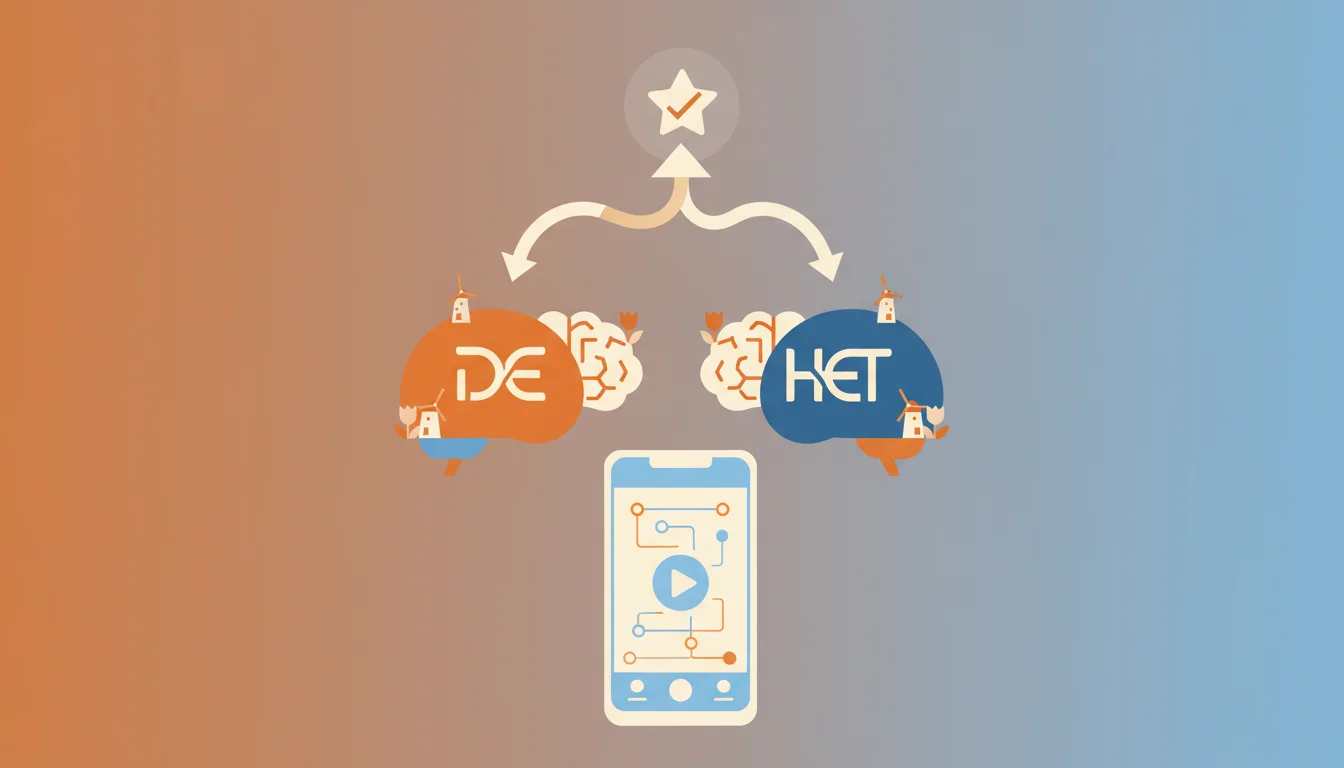
How StroopTaal Helps You Master De and Het
The Ultimate Dutch Challenge: Conquering De and Het Ask any expat living in the Netherlands about their biggest language learning hurdle, and you...
Read more
If you have been learning Dutch for more than five minutes, you have likely encountered the most notorious villain in the Dutch language: the definite articles. In English, life is simple; you have "the." The house, the cat, the interview. In Dutch, however, every noun is assigned a gender, dictating whether it is a de word (masculine/feminine) or a het word (neuter).
For expats and learners, this 50/50 guess often leads to the dreaded "foreigner freeze"—that pause in the middle of a sentence where you frantically scan your memory banks. "Mag ik... uh... de? Nee, het? ...water, alstublieft?"
While native speakers pick this up intuitively growing up, adult learners need a smarter strategy. In this StroopTaal review, we will explore the rules you can actually memorize and look at how our app's De/Het article mastery games turn this grammatical headache into an addictive challenge.
You might be tempted to think, "If I get it wrong, people will still understand me." And you are right—they will. However, mastering "de" and "het" is crucial for two main reasons:
Before we dive into how technology can save you, here is a quick "cheat sheet" of rules that have very few exceptions. Memorizing these is the first step to building your confidence.
Memorizing lists is boring. This is where the modern approach shines. In our development of StroopTaal, we realized that "de" and "het" mastery is not about intelligence; it is about pattern recognition and muscle memory.
Here is how the app tackles this specific pain point:
StroopTaal features a dedicated module specifically for articles. Think of it like a rapid-fire card game. You are presented with a noun, and you simply swipe or tap to assign the gender. It sounds simple, but this rapid repetition trains your brain to associate the sound of the word with the correct article without overthinking it.
This is the "smart" part of the app. If you consistently struggle with neutral nouns (het-words) that relate to transport, StroopTaal's algorithm notices. It won't just keep showing you de tafel (which you already know); it will adapt to surface the words you struggle with. This vocabulary building with spaced repetition ensures you are spending time on your weak spots, not reviewing what you have already mastered.
Learning words in isolation is difficult. StroopTaal uses interactive dialogue games for practical scenarios. Instead of just seeing the word "ticket" (kaartje), you practice it in a sentence: "Mag ik het kaartje zien?" By hearing the article used in context with pronunciation training with instant feedback, the rhythm of the correct grammar sticks in your head much faster than rote memorization.
We cannot finish a post about Dutch articles without addressing the most confusing word for English speakers: Het meisje (the girl). Why is a girl "it"?
As mentioned in the rules above, all diminutives are het. The base word is de meid (the maid/girl - archaic), but the diminutive meisje is what is used in modern Dutch. Because it ends in -je, it must be het. Logic prevails!
Mastering de and het is the difference between sounding like a tourist and sounding like a local. While the rules can seem overwhelming, they are finite. By combining a knowledge of the basic suffixes with daily practice, you can rewire your brain to pick the right article instinctively.
Don't let a two-letter word hold back your fluency. Whether you are aiming for a C1 level or just want to order a coffee with confidence, StroopTaal provides the structured, engaging environment you need to succeed in learning Dutch.
Ready to conquer Dutch grammar? Download StroopTaal today and start your daily streak!
Share this article:
The Ultimate Dutch Challenge: Conquering De and Het Ask any expat living in the Netherlands about their biggest language learning hurdle, and you...
Read moreMoving to the Netherlands brings a whirlwind of excitement: the bicycles, the canals, the stroopwafels, and, inevitably, the language barrier. While...
Read moreIf you have ever tried to learn Dutch, you are likely familiar with the unique struggles that come with it. From mastering the guttural G sound to...
Read more