Online vs In-Person Inburgering: Which Path is Right for You?
Is Remote Learning for Inburgering Effective? Comparing Online vs. In-Person Classes The journey to passing your inburgeringsexamen is a pivotal step...
Read more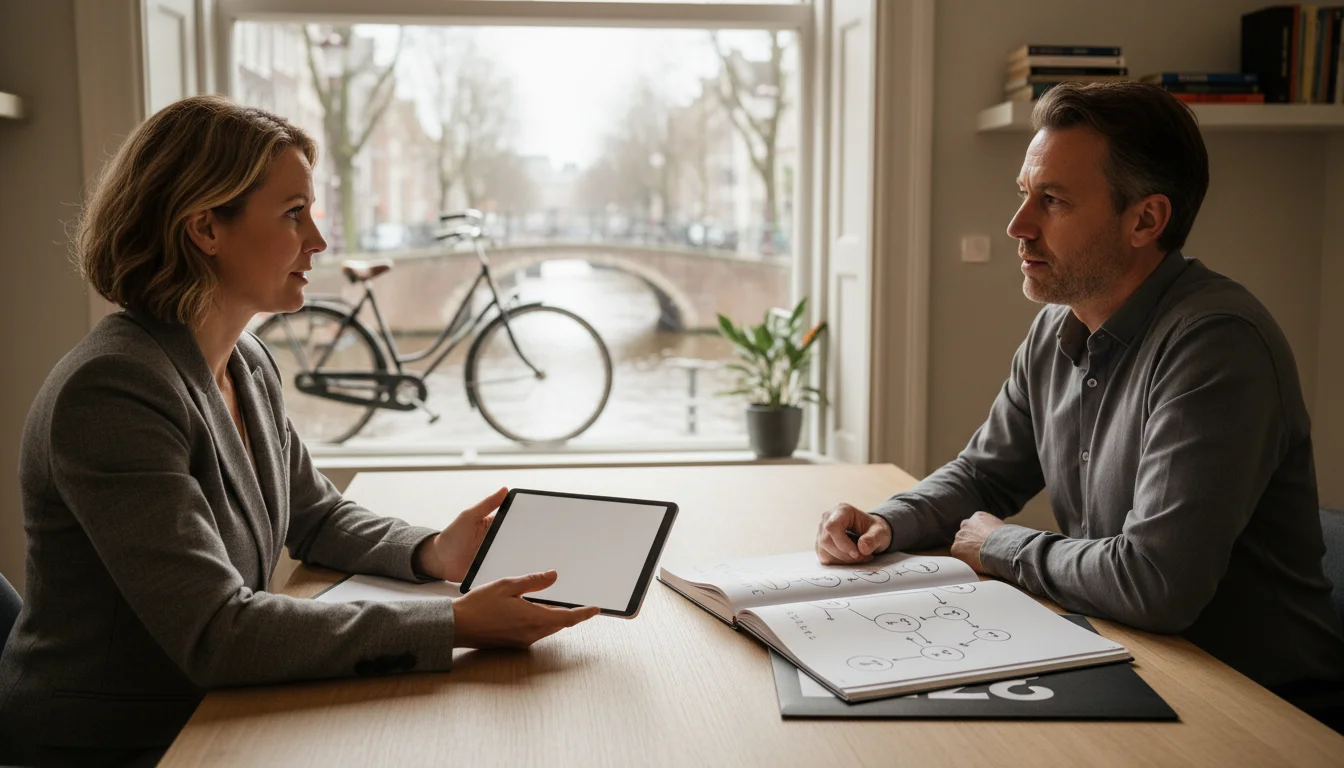
You’ve navigated the paperwork, built your portfolio, and spent countless hours learning the Dutch language. Now, one final conversation stands between you and completing a crucial part of your integration journey: the ONA interview. For many, this final exam (eindgesprek) for Orientation on the Dutch Labour Market (Oriëntatie op de Nederlandse Arbeidsmarkt) can feel like the most intimidating step. You’re not just reciting facts; you’re discussing your professional life, ambitions, and understanding of the Dutch workplace—all in Dutch.
But fear not. This interview isn’t designed to trick you. It’s a conversation to verify that the work you did in your portfolio is your own and that you have a realistic plan for finding work in the Netherlands. With the right preparation, you can walk into that room with confidence and walk out knowing you’ve successfully demonstrated your readiness for the Dutch job market. This comprehensive guide will break down what to expect in your 2026 ONA interview, the types of questions you’ll face, and how to formulate answers that impress.
ONA is a mandatory component of the Dutch civic integration exam (inburgeringsexamen) for most people. Its purpose is to ensure you understand how to find a job or start a business in the Netherlands. It shows the government, specifically DUO (Dienst Uitvoering Onderwijs), that you can function independently in the professional world. For a complete overview of the entire process, our complete 2026 guide to DUO and Dutch integration is an essential resource.
The ONA process consists of two parts:
Think of your portfolio as the script and the interview as the performance. The interviewer has read your script; now they want to see if you, the actor, truly understand the lines and the character you’re playing—your professional self in the Netherlands.
Before we dive into interview questions, it’s crucial to understand that your portfolio is the bedrock of your preparation. The entire interview will revolve around the choices, research, and reflections you documented. The interviewer will use your submitted result cards as a guide for their questions. Therefore, the single most important preparation tip is to know your own portfolio inside and out.
The 8 result cards cover themes like:
Before your interview, print a copy of your portfolio and read it multiple times. Ask yourself: Why did I choose this profession? What did I learn from the informational interview I conducted? What was the most challenging part of this process? The answers to these self-reflective questions are the core of what you'll discuss.
While every interview is unique, the questions fall into several predictable categories directly linked to your portfolio. Let's break down what you can expect and how to prepare for each theme.
This section is about you, your skills, and your chosen career path. The interviewer wants to see that you've thought realistically about your profession in the Dutch context.
Potential Questions:
How to Answer: Be specific and passionate. Don't just say, "I like being a software developer." Say, "I chose software development because I am a logical problem-solver, and I enjoy creating tools that make people's lives easier. My experience with Python and Java, as mentioned in my CV, is highly relevant to the vacancies I found." If your diplomas need validation, mention that you are aware of the process through IDW (Internationale Diplomawaardering) and have a plan for it.
Here, the interviewer assesses whether you know how to find a job in the Netherlands. They want to see practical knowledge.
Potential Questions:
How to Answer: Name specific Dutch job boards (e.g., Indeed.nl, Nationale Vacaturebank, LinkedIn). Refer directly to the vacancy you included in your portfolio. Discuss the specific requirements (e.g., "They required HBO level thinking and working ability, fluency in English, and at least three years of experience with project management tools like Asana."). For your CV, mention that Dutch CVs are typically 1-2 pages and do not include a photo unless requested.
Networking is vital in the Dutch job market. This part of the conversation checks if you understand its importance and have taken steps to build your own professional circle.
Potential Questions:
How to Answer: Explain that networking can lead to unadvertised jobs (the 'hidden job market'). Detail the concrete steps you've taken: attending a job fair, contacting someone on LinkedIn for an informational interview, or talking to neighbors and friends about your job search. When discussing your informational interview, share a specific piece of advice you received that was helpful.
This is about more than just finding a job; it’s about succeeding in one. The interviewer wants to know if you understand the unwritten rules of the Dutch workplace.
Potential Questions:
How to Answer: Mention key concepts like direct communication, flat hierarchies (platte structuur), the importance of punctuality, and collaborative decision-making (poldermodel). You can say, "I learned that it's normal to voice your opinion to your manager, which is different from my home country where the hierarchy is stricter." For a deeper dive into this topic, exploring Dutch cultural competence is key for your integration.
Knowing the topics is one thing; structuring your answers effectively is another. A fantastic tool for this is the STAR method. It helps you provide concrete, evidence-based answers rather than vague statements. It’s perfect for questions about your past experiences or how you solved a problem.
Example Question: "Heeft u een keer een moeilijk probleem opgelost op uw werk?" (Have you ever solved a difficult problem at work?)
STAR Answer:
"Jazeker. (S) In mijn vorige baan als marketingmedewerker merkten we dat de online verkoop al drie maanden daalde. (T) Mijn taak was om de oorzaak te vinden en een plan te maken om de verkoop te verbeteren. (A) Ik heb de websitegegevens geanalyseerd en zag dat veel klanten hun aankoop stopten op de betaalpagina. Ik heb toen met het IT-team gewerkt om het proces simpeler te maken met minder stappen. (R) Hierdoor steeg de online verkoop binnen een maand met 15% en heb ik geleerd hoe belangrijk een gebruiksvriendelijke website is."
Confidence comes from preparation. Follow these steps in the weeks leading up to your interview:
The ONA interview is the culmination of your hard work and research into the Dutch labour market. It's your chance to show that you are not just a passive resident but an active participant, ready to contribute your skills and build a future in the Netherlands. By thoroughly understanding your portfolio, anticipating the types of questions you'll be asked, and practicing how to articulate your answers clearly and confidently, you can turn this final exam from a source of anxiety into a moment of pride.
Remember, the goal is not to speak flawless, C1-level Dutch. The goal is to communicate effectively and demonstrate that you have a realistic, well-researched plan. You've already done the hard work by creating the portfolio. Now, it's time to talk about it. Heel veel succes!
Share this article:
Is Remote Learning for Inburgering Effective? Comparing Online vs. In-Person Classes The journey to passing your inburgeringsexamen is a pivotal step...
Read moreBeyond Language: The Key to Successful Dutch Integration in 2026 You've spent months, maybe even years, mastering the difference between 'de' and...
Read moreThat Sinking Feeling: When Spoken Dutch Becomes a Blur You’ve been studying hard. You can read a Dutch news article, write a decent email, and...
Read more