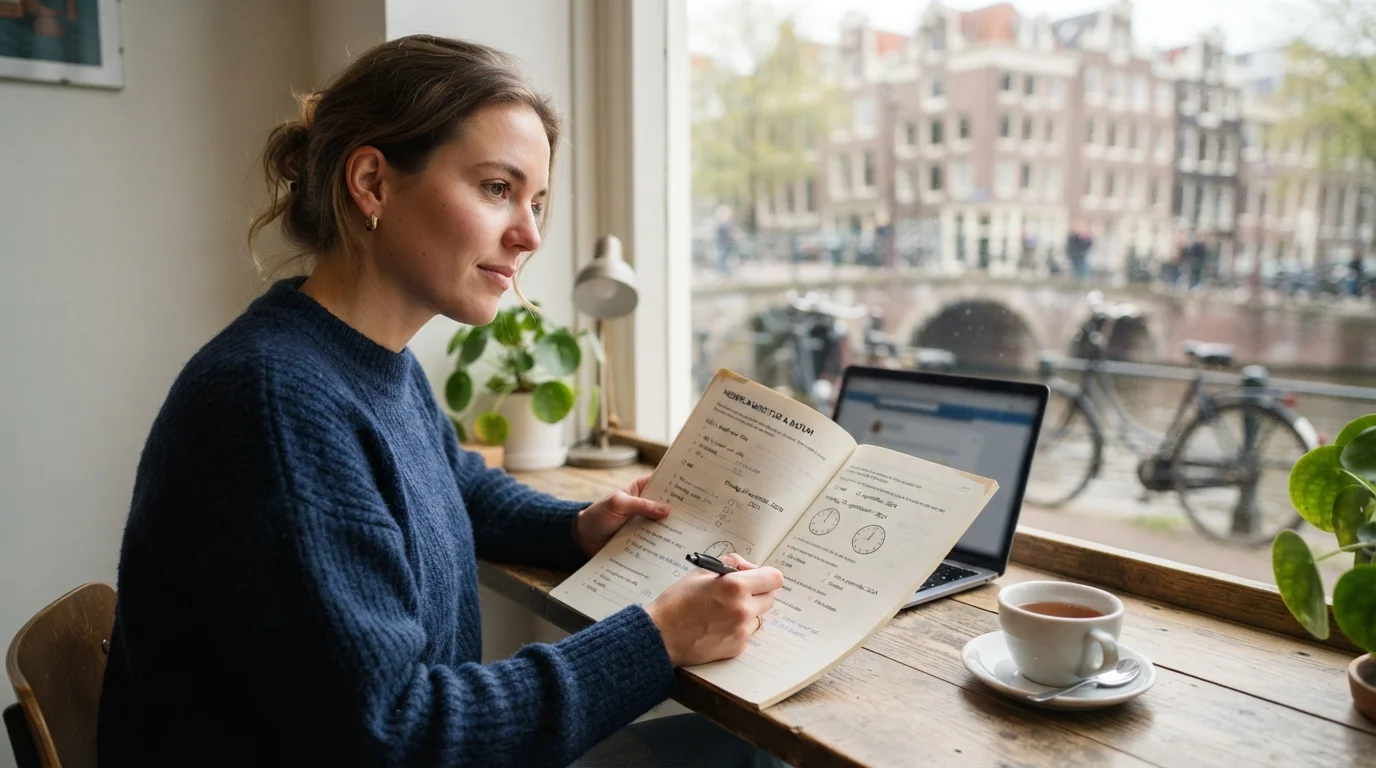
How to Correctly Express Time and Dates in Dutch
Few things throw English speakers off balance quite like arranging an appointment in the Netherlands. You agree to meet a colleague at half drie,...
Read more
When you start learning Dutch, communicating feels straightforward: you make simple statements, ask direct questions, and recount your day using direct quotes. But as you transition toward intermediate Dutch (CEFR B1 and B2) or prepare for professional life in the Netherlands, you quickly discover that native speakers rarely report conversations verbatim. Instead of saying, Jan zei: "Ik kan morgen niet komen", they say, Jan zei dat hij morgen niet kon komen.
This construction is known as indirect speech (de indirecte rede). Shifting from direct speech to indirect speech is one of the most critical milestones in Dutch grammar. It requires juggling three major grammatical mechanisms simultaneously: selecting the right conjunction, reorganizing word order into a subordinate clause (bijzin), and adjusting pronouns and verb tenses.
Whether you are drafting an email to a colleague, reporting a phone call to a doctor, or studying for the Staatsexamen NT2 or Inburgering examination, mastering indirect speech will transform your Dutch from robotic to natural. In this comprehensive guide, we will break down every rule, explore common pitfalls, and show you exactly how verb shifting works in the Dutch language.
Before diving into conjunctions and word order, let us establish a clear contrast between the two ways of reporting what someone said:
According to standard Dutch linguistics recognized by institutions like the Taalunie, turning an utterance into indirect speech automatically subjects it to the grammatical constraints of Dutch subordinate clauses. That means the verb position must shift.
In a standard Dutch main clause (hoofdzin), the conjugated verb occupies the second position (known as V2 word order). However, whenever you report speech using a conjunction, you create a subordinate clause (bijzin). In a Dutch subclause, all verbs get pushed to the very end of the sentence.
The standard structure of an indirect clause follows this pattern:
[Introductory Clause] + [Conjunction] + [Subject] + [Time / Manner / Place / Objects] + [Verbs]
Look at how the verb position changes in these examples:
If there is an auxiliary or modal verb combined with an infinitive or past participle, both verbs head to the end:
Separable verbs (scheidbare werkwoorden) like opbellen, meenemen, and schoonmaken split apart in main clauses: "Ik bel je morgen op."
In indirect speech, because the verb relocates to the end of the clause, the separable prefix rejoins the verb root:
The connector you choose depends entirely on the type of sentence you are reporting: a statement, a yes/no question, or an open question.
When reporting a declarative sentence, connect the reporting clause to the subordinate clause with dat (that):
In English, speakers often drop "that" (e.g., "He said he was coming"). In Dutch, you cannot omit dat in indirect speech. Leaving it out leads to awkward, incorrect grammar.
If the original statement was a closed question (one that can be answered with "ja" or "nee"), use of (meaning "if" or "whether"):
When reporting a question that begins with an interrogative pronoun (wie, wat, waar, wanneer, waarom, hoe, welke), do not add dat or of. Simply reuse the original question word as your conjunction:
When reporting scheduled events or deadlines, make sure you know how to correctly express time and dates in Dutch so your indirect phrases remain clear and accurate.
How do you report a command like "Houd je mond!" (Be quiet!) or "Stuur het rapport vandaag" (Send the report today)? You cannot put an imperative directly into a subordinate clause. Instead, Dutch provides two primary solutions:
The most common approach in spoken Dutch is to rephrase the command using moeten (must / have to):
If the command is an instruction or polite request rather than a strict order, Dutch speakers may also use vragen of alongside willen:
To avoid confusing orders with prohibitions or optional tasks, it helps to understand the subtle distinction between hoeven and moeten, particularly when reporting negative instructions (e.g., "Je hoeft niet te komen" vs. "Je mag niet komen").
Another clean and formal way to convey requests is by using an infinitive construction with om ... te:
Learners coming from an English background often struggle with tense shifts (also known as backshifting or consecutio temporum). In English, if the reporting verb is in the past, the reported verb almost always shifts backward into the past:
"I am tired" → He said he was tired.
In Dutch, the rules are considerably more flexible:
If the reported statement is still true, ongoing, or relevant in the present moment, Dutch speakers frequently leave the verb in the present tense, even when the introductory verb is in the simple past (onvoltooid verleden tijd):
You can also backshift to the past tense, exactly as in English. This is particularly common in written Dutch, journalism, formal literature, or when the situation is completely in the past:
Here is a summary table comparing original statements with their indirect equivalents:
| Direct Statement | Indirect (Present / Relevant) | Indirect (Backshifted) |
|---|---|---|
| "Ik heb geen tijd." | Hij zei dat hij geen tijd heeft. | Hij zei dat hij geen tijd had. |
| "Ik ga verhuizen." | Zij zei dat ze gaat verhuizen. | Zij zei dat ze ging verhuizen. |
| "Ik ben geslaagd." | Hij vertelde dat hij is geslaagd. | Hij vertelde dat hij was geslaagd. |
When you report someone else's speech, you are speaking from your own temporal and physical perspective. Therefore, pronouns, time markers, and spatial references must adjust logically.
First-person pronouns (ik, wij, me, ons, mijn) typically shift to third-person pronouns (hij, zij, hem, haar, hun), depending on who is doing the talking:
If you report an utterance on a different day than it occurred, time indicators must reflect the current perspective:
In spoken conversation, nuances are often smoothed out with small conversational words. Knowing how to use Dutch modal particles like eens, even, and zomaar will help you capture the informal tone of the original speaker when quoting them naturally.
Locations and pointing words shift relative to the speaker:
Even advanced learners make recurring errors when switching between direct and indirect speech. Watch out for these three traps:
In English, indirect questions keep the subject before the verb ("She asked where I live"). In Dutch, learners sometimes mistakenly retain question inversion:
Because English does not push verbs to the end of a subordinate clause, native English speakers often leave the auxiliary verb right behind the subject:
Both of and als can translate to "if" in English, but their functions in Dutch are strictly divided:
In indirect questions, you must always use of, never als.
To master indirect speech, you need regular, focused practice that pushes you to restructure sentences on the fly. Here are two practical exercises you can do independently:
If you prefer structured practice on your phone or tablet, language apps can make a major difference. For instance, StroopTaal teaches the Dutch of daily life, work, and the exams through short lessons spanning A0 to C1. Its curriculum incorporates interactive grammar tips, sentence ordering exercises, and typing drills where you see why an answer is right or wrong immediately.
If you are drafting professional emails or preparing for the inburgering or Staatsexamen NT2 writing exams, you can also take advantage of StroopTaal's Sentence Check feature (available with Premium), which corrects sentences you write and explains grammatical slips — including misplaced verbs in subordinate clauses.
Whenever you need to report speech in Dutch, run through this mental checklist:
With consistent practice, shifting verbs and selecting conjunctions will quickly become second nature, giving you the confidence to communicate accurately and professionally in Dutch.
Share this article:
Few things throw English speakers off balance quite like arranging an appointment in the Netherlands. You agree to meet a colleague at half drie,...
Read moreHave you ever felt that your Dutch is grammatically spotless, yet native speakers sound completely different when they chat by the coffee machine?...
Read moreIf you have ever walked through a Dutch train station and seen signs for a fietsenstalling (bicycle parking), koffieautomaat (coffee machine), or...
Read more