Best Dutch Learning Apps for Kids: Fun Tools for Bilingual Families
Introduction: The Journey to a Bilingual Family in the Netherlands Moving to the Netherlands as an expat family is an incredible adventure, filled...
Read more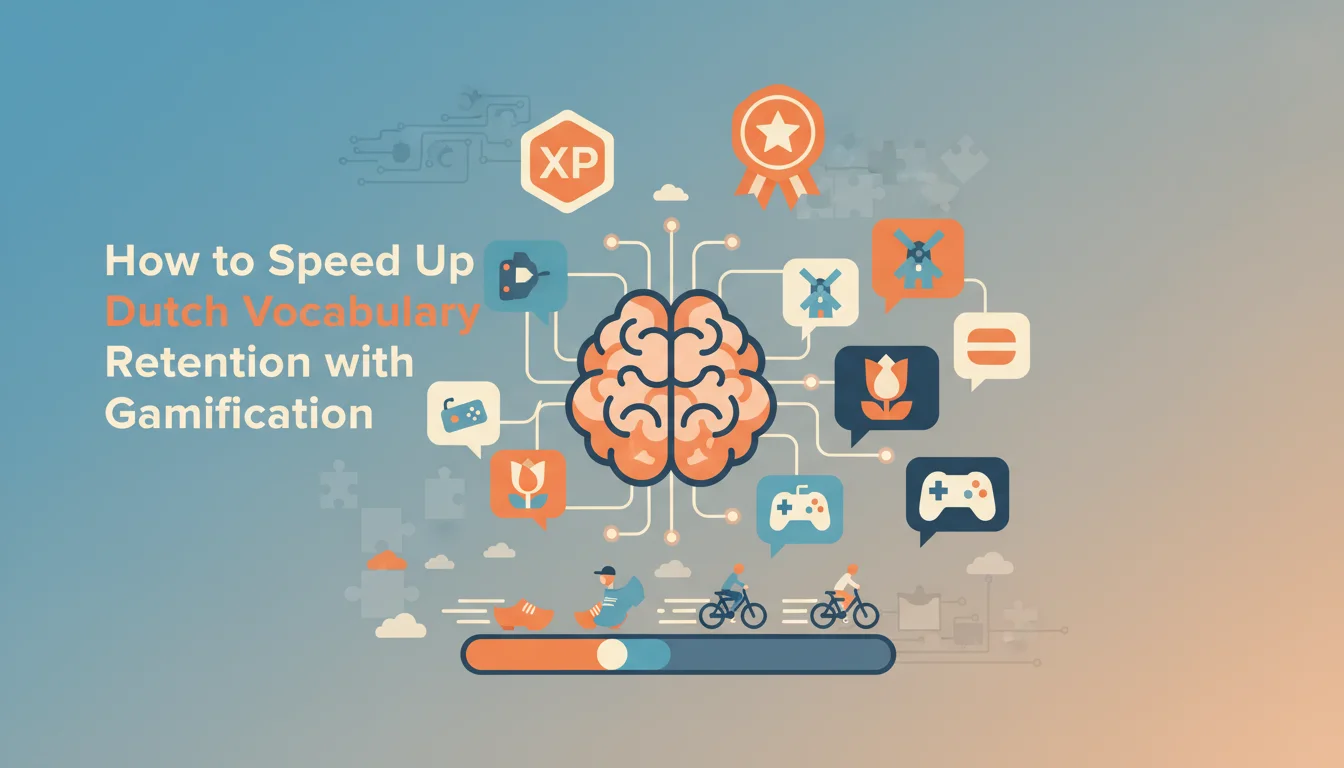
If you have ever stared blankly at a Dutch supermarket label trying to decipher the difference between pindakaas and kaas, or found yourself lost in a conversation because the Dutch speaker used a word that sounded vaguely familiar but ultimately escaped you, you are not alone. Learning a new language as an adult is notoriously challenging, and Dutch, with its unique phonetics, compound words, and complex grammar rules, presents its own special set of hurdles for expats and international students.
One of the biggest roadblocks to fluency is vocabulary retention. You might spend an hour studying a list of new words on Sunday, feeling confident that you have mastered them. However, by Wednesday, words like gezellig (cozy/sociable), boodschappen (groceries), and ziekenhuis (hospital) have completely vanished from your memory. This frustrating cycle of learning and forgetting is a universal experience, scientifically known as the Ebbinghaus forgetting curve.
But what if learning Dutch didn't have to feel like a tedious academic chore? What if you could trick your brain into absorbing and retaining vocabulary faster, all while actually having fun? This is where the power of gamification comes into play. By combining proven cognitive science with engaging game mechanics, learners can drastically accelerate their progress. In this comprehensive guide, we will explore how gamified features can speed up your Dutch vocabulary retention and help you navigate life in the Netherlands with confidence.
To understand why gamification is so effective, we have to look at how the human brain processes and stores new information. Traditional rote memorization—staring at static lists of words until they stick—is highly inefficient. It leads to high cognitive load and quick burnout. Gamification, on the other hand, taps into the brain's natural reward systems.
When you play a game and achieve a goal, whether it is scoring points, unlocking a new level, or maintaining a streak, your brain releases dopamine. Dopamine is a neurotransmitter heavily involved in the brain's pleasure and reward centers. Crucially, dopamine also plays a significant role in learning and memory consolidation. When a learning activity triggers a dopamine release, your brain tags the associated information as important, making it much easier to recall later.
This is a core concept in the field of second-language acquisition. When learners are engaged, relaxed, and motivated, their "affective filter" lowers. A high affective filter—often caused by anxiety or boredom—blocks comprehensible input from reaching the language acquisition part of the brain. Gamification lowers this filter, creating an optimal environment for absorbing Dutch vocabulary.
Gamification forces you to be an active participant rather than a passive consumer. Instead of just reading that fiets means bicycle, a gamified system might ask you to match the word to an image, type it out against a ticking clock, or use it in an interactive dialogue game. This active retrieval strengthens the neural pathways associated with the word, ensuring that it moves from short-term to long-term memory much faster.
While games make learning fun, the underlying engine that truly drives vocabulary retention is Spaced Repetition. A Spaced Repetition System (SRS) is an algorithm that predicts when you are about to forget a word and prompts you to review it right before that happens.
Imagine you learn the word verjaardag (birthday) today. If you review it tomorrow, you will likely remember it. The SRS will then wait three days before showing it to you again. If you remember it then, it might wait a week, then a month, and so on. If you forget it, the interval resets. This method is infinitely more efficient than reviewing every word every day.
When comparing flashcard apps for learning Dutch, it becomes clear that not all spaced repetition systems are created equal. Traditional flashcards can get boring quickly. However, when an app like StroopTaal builds spaced repetition directly into its vocabulary building exercises, the experience transforms. The AI looks at the grammar you often get wrong and the words you keep missing, and personalizes your learning plan accordingly. You are not just flipping cards; you are interacting with a dynamic system designed specifically for your brain.
Ask any expat in the Netherlands what the most frustrating part of learning Dutch is, and you will almost certainly hear about "de" and "het." Unlike English, which just uses "the," Dutch has two definite articles. "De" is used for masculine and feminine nouns, while "het" is used for neuter nouns. To make matters worse, there are very few hard and fast rules for predicting which article a noun takes.
Is it de boek or het boek? (It's het boek). Is it de tafel or het tafel? (It's de tafel). Using the wrong article not only sounds unnatural to native speakers but also affects the spelling and grammar of adjectives attached to the noun.
Because rote memorization of articles is so tedious, gamification is an absolute lifesaver here. If you are focused on mastering de and het articles, interactive games that force you to make split-second decisions are highly effective. For example, StroopTaal features a specialized De/Het article game where you swipe each noun card toward "De" or "Het".
This gamified approach works because it builds an intuitive, gut-level feeling for the language. Over time, het tafel will start to "feel" wrong, just as saying "a apples" feels wrong to an English speaker. You stop thinking about the grammar rules and start relying on the linguistic instincts you have developed through play.
The most important factor in language learning is not natural talent, IQ, or living in the target country—it is consistency. Studying Dutch for 15 minutes every single day will yield vastly superior results compared to binge-studying for three hours once a week. However, building a daily habit is incredibly difficult amidst the busy life of an expat or working professional.
This is where gamified streak systems shine. A daily streak counter tracks how many consecutive days you have met your learning goal. While it might seem like a simple psychological trick, the power of loss aversion makes it highly effective. Once you have built a 30-day streak, the desire not to "break the chain" becomes a powerful motivator to log in, even on days when you feel exhausted.
Long-term success comes down to integrating language apps into your daily routine seamlessly. Gamification makes this integration feel like a rewarding break rather than an obligation. By pairing your daily vocabulary review with an existing habit—such as drinking your morning coffee or commuting on the train—you ensure that your daily streak continues to grow, and along with it, your Dutch vocabulary.
For many expats living in the Netherlands, learning Dutch isn't just about integrating into society; it is a legal requirement. The Inburgeringsexamen (civic integration exam) tests your proficiency in reading, writing, listening, and speaking, as well as your knowledge of Dutch society (KNM).
Recently, the Dutch government raised the required language proficiency level for the exam from A2 to B1 for many newcomers. You can find the most up-to-date requirements and information from the Immigration and Naturalisation Service (IND). This shift to B1 means that learners need a significantly larger vocabulary to pass. At the B1 level, you are expected to understand the main points of clear standard input on familiar matters regularly encountered in work, school, and leisure.
Gamified learning drastically accelerates the journey to B1. When preparing for the reading and listening exams, a robust vocabulary is your best defense. If you know the core nouns and verbs in a sentence, you can often deduce the meaning of the entire paragraph, even if the grammar is complex.
Furthermore, apps like StroopTaal offer specific cultural lessons and interactive dialogue games for practical scenarios—like visiting the gemeente (municipality), talking to a doctor, or navigating a Dutch workplace. By gamifying these real-life scenarios, you are not just memorizing abstract words; you are practicing everyday situations, which also helps you get ready for the Inburgering speaking and listening exams.
Mastering Dutch vocabulary does not have to be a painful process of staring at flashcards until your eyes glaze over. By leveraging the science of gamification, spaced repetition, and daily streaks, you can transform language learning from a chore into an engaging, highly rewarding daily habit.
Gamified features lower your affective filter, trigger dopamine release to consolidate memories, and build the crucial consistency required to reach fluency. Whether you are aiming to pass your B1 Inburgering exam, finally master those tricky "de" and "het" articles, or simply want to chat with your Dutch colleagues at the coffee machine, gamification is the key to speeding up your vocabulary retention. Ready to stop forgetting and start speaking? Dive into a gamified learning experience today and watch your Dutch vocabulary grow faster than ever before.
Share this article:
Introduction: The Journey to a Bilingual Family in the Netherlands Moving to the Netherlands as an expat family is an incredible adventure, filled...
Read moreTurn Your Daily Commute into a Dutch Language Classroom Living in the Netherlands as an expat usually means one thing: you are going to spend a...
Read moreWelcome to the Future of Fluency: Learning Dutch in 2026 If you have recently moved to the Netherlands, you are likely familiar with the...
Read more