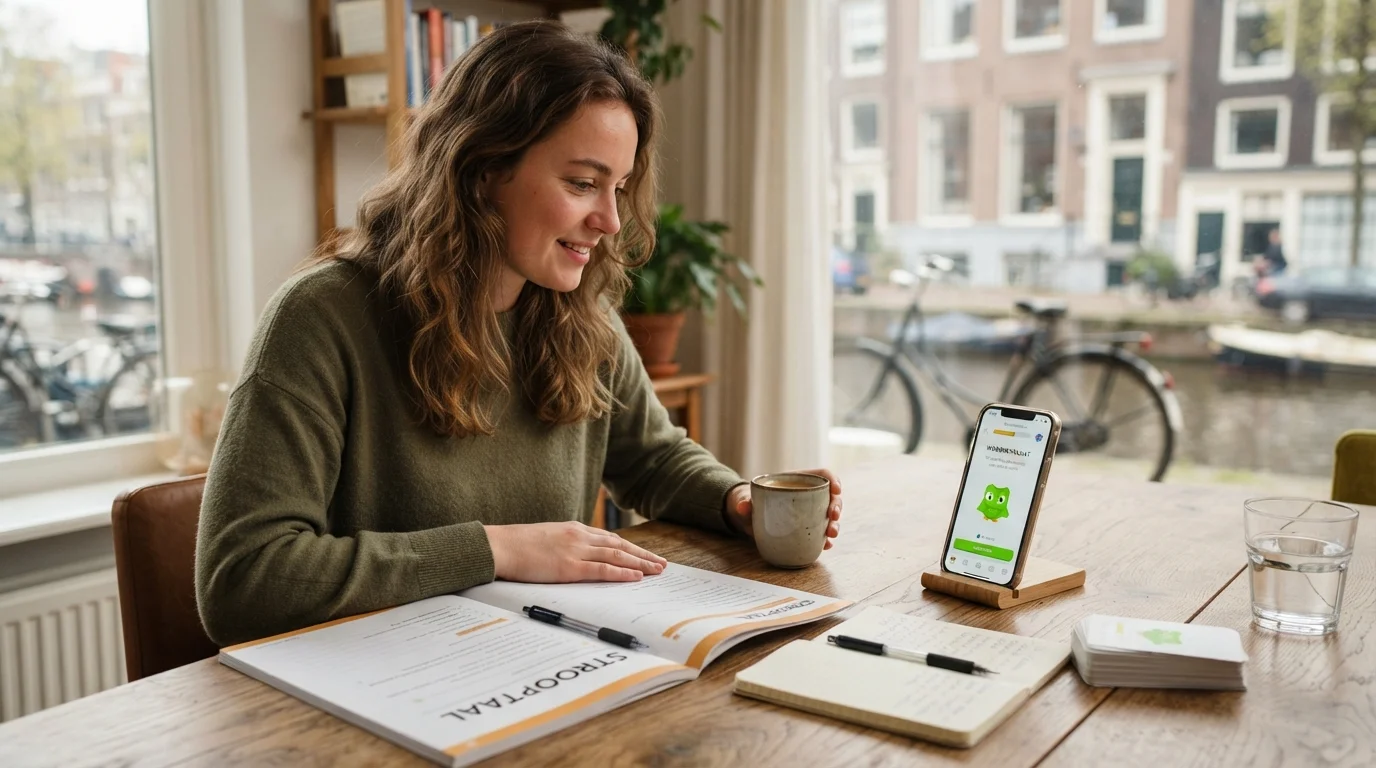
StroopTaal App Review 2026: The Best Tool for Dutch Noun Genders?
Introduction: The Infamous 'De' vs 'Het' Struggle If you have spent more than ten minutes learning Dutch, you have undoubtedly stumbled across the...
Read more
Moving to the Netherlands is a thrilling adventure. Between navigating the scenic canals of Amsterdam, setting up your new apartment, adapting to the workplace culture, and figuring out the complex Dutch tax system, your schedule is packed. You arrive with the best of intentions: "I will learn Dutch and speak like a local within a year!"
But then reality sets in. Traditional language courses require you to commit to three-hour evening classes twice a week, plus hours of homework. After a long day of work, the last thing you want to do is sit in a cold classroom conjugating verbs. The books collect dust, and you find yourself falling back on the comfortable safety net of English. After all, almost everyone in the Netherlands speaks impeccable English. But deep down, you know that relying on English keeps you in an "expat bubble," detached from the rich culture, local community, and long-term career opportunities around you.
Fortunately, you do not need to spend hours a day studying to achieve fluency. The secret to mastering Dutch lies in a modern pedagogical approach: micro-learning. By breaking down language acquisition into highly focused, bite-sized daily sessions, you can fit learning into the cracks of your busy schedule. In this comprehensive guide, we will explore how best apps to learn Dutch on your phone utilize micro-learning, and how StroopTaal is specifically engineered to help busy expats build a sustainable, daily Dutch habit.
Micro-learning is an educational strategy that delivers content in small, highly specific bursts. Instead of trying to digest a massive grammar chapter in one sitting, you learn a single concept—such as how to use the diminutive suffix (-tje) or when to use de versus het—in under five minutes. This approach is not just convenient; it is backed by cognitive science.
In the late 19th century, psychologist Hermann Ebbinghaus discovered the "Forgetting Curve," which demonstrates how quickly human memory decays over time if information is not reinforced. When you cram for two hours once a week, you forget up to 80% of what you learned within a few days. Micro-learning combat this by utilizing spaced repetition.
By reviewing small chunks of information at scientifically optimized intervals, you push the vocabulary from your short-term memory into your long-term memory. If you want to know more about the underlying mechanics, read about how StroopTaal uses spaced repetition to lock in Dutch vocabulary. This method ensures you spend your limited time only reviewing words you are on the verge of forgetting, making your study sessions incredibly efficient.
Our working memory has a limited capacity. When you are presented with too much new information at once, your brain experiences cognitive overload, leading to frustration and burnout. Micro-learning keeps the cognitive load light. By focusing on one small objective at a time, your brain processes and stores the information with ease, leaving you feeling accomplished rather than exhausted.
StroopTaal was designed from the ground up for the modern, busy expat. It does not ask you to change your lifestyle; instead, it seamlessly integrates into your existing daily routine. Here is how StroopTaal's micro-learning features turn idle moments into productive learning opportunities:
No two expats have the exact same goals or starting points. A software engineer in Utrecht needs different vocabulary than a marketing manager in Rotterdam. StroopTaal uses advanced AI to assess your current level and build a personalized learning plan that adapts to your progress. Whether you are starting from scratch at the A0 level or polishing your skills at B2, the app serves up short, targeted lessons that match your exact needs.
One of the biggest hurdles for Dutch learners is mastering grammatical gender. Unlike English, Dutch nouns are preceded by either de or het, and getting them wrong can sound unnatural. StroopTaal features dedicated article mastery games designed to turn this frustrating grammar point into a quick, intuitive game. In just two minutes while waiting for the NS train or riding the tram, you can train your brain to instinctively pair the correct article with its noun.
Many expats struggle with the transition from reading Dutch to speaking it. StroopTaal solves this by offering real-life conversation practice with an intelligent AI partner. You can engage in realistic, low-pressure dialogue games that simulate everyday scenarios—such as ordering a coffee ("Mag ik een havermelk cappuccino, alstublieft?"), talking to a neighbor, or visiting the local municipality (gemeente). These bite-sized conversations build your confidence without the anxiety of speaking to a native speaker before you are ready.
Dutch pronunciation can be notoriously difficult for English speakers, with guttural "g" sounds, diphthongs like "ui" and "eu," and long vowels. StroopTaal's built-in pronunciation training analyzes your speech in real-time and provides instant, constructive feedback. You can practice speaking in short, 1-minute bursts, perfecting your accent privately before taking your skills out into the real world.
For many expats, learning Dutch is not just a personal goal; it is a legal requirement. If you plan to apply for permanent residency or Dutch citizenship, you must pass the civic integration exams (Inburgeringsexamen). Navigating the official requirements set by the Immigration and Naturalisation Service (IND) can feel overwhelming, especially with the transition of the required language level from A2 to B1.
Preparing for these exams does not require months of intensive bootcamps. By utilizing StroopTaal's curated exam preparation modules, you can break down the reading, writing, listening, and speaking components of the exam into daily, manageable tasks. Spending 10 minutes a day on targeted exam prep over six months is far more effective—and significantly less stressful—than trying to cram all the material in the weeks leading up to your exam date. You can track your progress with a readiness score for each part, practice with timed exercises, and check the official requirements with the Dutch Government.
Understanding the value of micro-learning is one thing; putting it into practice is another. Here are some actionable tips to help you build a consistent daily learning habit with StroopTaal:
Learning Dutch does not have to be an all-or-nothing endeavor. You do not need to sacrifice your weekends or your precious free time to integrate into Dutch society. By embracing the power of micro-learning, you can make steady, compounding progress every single day, turning what once felt like an insurmountable obstacle into an enjoyable, rewarding daily routine.
StroopTaal is designed to guide you through this journey, one small step at a time. With personalized AI paths, engaging dialogue games, and targeted vocabulary training, you will be surprised by how quickly those daily five-minute sessions translate into real-world confidence. Stop waiting for the "perfect time" to start learning Dutch—download StroopTaal today and unlock the door to your new life in the Netherlands.
Share this article:
Introduction: The Infamous 'De' vs 'Het' Struggle If you have spent more than ten minutes learning Dutch, you have undoubtedly stumbled across the...
Read moreAre you planning a move to the Netherlands, or are you already living there, trying to decipher the difference between de and het? Learning Dutch can...
Read moreWe’ve all been there: the persistent green owl staring at you from your phone screen, demanding that you complete your daily Dutch lesson. Duolingo...
Read more