Dutch Vowels: A Pronunciation Guide for English Speakers

Dutch Vowels: A Pronunciation Guide for English Speakers

Why Do Dutch Vowels Sound So Tricky? An Introduction

You’ve just started learning Dutch. You’re feeling confident. You see the word huis and think, "Easy, that's 'house'." But when you say it, your Dutch friend gives you a puzzled look. You’ve just stumbled upon one of the biggest hurdles for English speakers: Dutch vowel pronunciation. While the two languages are Germanic cousins, their vowel systems have drifted far apart, leading to common and often comical misunderstandings.

The problem isn't that you can't make the sounds; it's that your English-speaking brain is wired differently. English is full of diphthongs—vowels that glide from one position to another within a single syllable (think of the 'o' in "go"). Dutch, on the other hand, loves its 'pure' vowels, or monophthongs, which demand a fixed mouth position. On top of that, it has a few sounds, like the infamous 'ui', 'eu', and 'uu', that simply don't have an English equivalent.

This comprehensive guide will break down the most common pronunciation challenges English speakers face with Dutch vowels. We'll explore pure vowels, dreaded diphthongs, the crucial concept of vowel length, and provide actionable tips to help you sound less like a tourist and more like a local. Let's dive in!

Dutch Vowel Sounds and Vowels in Dutch: An Overview

Dutch vowel sounds include short vowels, long vowels, and diphthongs, giving the language a richer palette of vowel sounds than standard English. While the written alphabet uses the standard letters a, e, i, o, u (and occasionally y), every single vowel in Dutch can take on multiple phonetic forms depending on its syllable structure.

Understanding vowels Dutch learners encounter starts with recognizing how they differ from English counterparts. English speakers naturally reduce unstressed vowels to a quick schwa or glide between mouth positions. In Dutch language pronunciation, pure vowels stay locked in place from start to finish, and syllable boundaries strictly determine whether a vowel is long or short. Learning how vowels behave in noun stems also pairs well with learning noun genders when you master de vs het nouns early in your studies.

The 'Pure' Vowel Challenge: Stop Gliding!

One of the most immediate giveaways of an English speaker's accent in Dutch is the tendency to turn pure vowels into gliding diphthongs. Your mouth moves when you say English vowels, but for many Dutch vowels, it needs to stay perfectly still.

The Dutch 'ee' vs. The English 'ay'

Consider the Dutch word zee (sea). An English speaker's instinct is to pronounce it like "say," where the sound glides into a 'y' at the end (s-ay-y). The Dutch 'ee' is a pure, long vowel. Your tongue and jaw should remain completely stationary throughout the sound.

  • Dutch: zee, meer (lake), thee (tea)
  • The Mistake: Pronouncing them as "zay," "mayr," or "tay."
  • The Fix: Say the English word "say" but freeze your mouth at the very beginning of the vowel sound and hold it. Your mouth should be in a slight, wide smile, and the sound should be consistent from start to finish.

The Dutch 'oo' vs. The English 'oh'

The same principle applies to the 'oo' sound, as in boot (boat). In English, we say "boat" with a glide towards a 'w' sound at the end (b-oh-w-t). The Dutch 'oo' is a pure sound made with rounded lips that don’t move.

  • Dutch: boot, rood (red), zoon (son)
  • The Mistake: Pronouncing them as "bowt," "rowd," or "zown."
  • The Fix: Start to say the English word "go," but again, freeze your mouth at the very start of the vowel. Keep your lips rounded and tense, and don't let them close into a 'w' shape.

Dutch Pronunciation Rules for Open and Closed Syllables

Dutch pronunciation rules dictate that a single vowel letter in an open syllable (ending in a vowel sound) is pronounced long, while a single vowel in a closed syllable (ending in a consonant) is pronounced short. For example, in bomen (trees), the first syllable bo- is open, so the single 'o' is pronounced long; in bommen (bombs), the double 'm' closes the first syllable (bom-), forcing the 'o' to remain short.

This structural rule applies across plurals, verb conjugations, and word formations such as mastering Dutch diminutives. Whenever you double a consonant in spelling, you protect the preceding short vowel sound. Conversely, when a syllable opens up during pluralization, a single vowel naturally lengthens.

Mastering the Unfamiliar: UI, EU, and IJ/EI

If pure vowels are a hurdle, these three diphthongs are the final boss for many learners. They have no direct English counterparts, so they require building new muscle memory in your mouth. Getting these right is a huge step towards sounding more natural, as they are central to achieving a more natural Dutch intonation.

The 'ui' Sound (as in huis)

This is arguably the most notorious sound in the Dutch language for foreigners. It is NOT the 'ow' in "house" or the 'ooey' in "gooey."

  • How to Make It: Start by trying to say the vowel in the English word "cat" (an /æ/ sound). From that position, begin to round your lips as if you are going to say "oo." The sound is the glide between these two positions. It should feel strange at first!
  • Common Mistake: Defaulting to "ow" or "oy."
  • Practice Words: huis (house), uit (out), tuin (garden), lui (lazy).

The 'eu' Sound (as in deur)

Another tricky one. This sound is often found in common words, so it's essential to master.

  • How to Make It: Start by making the vowel sound from the English word "her" or "sir" (an /ɜː/ sound). Hold that sound, and without moving your tongue, round your lips tightly as if you're whistling. The sound comes from this unique combination.
  • Common Mistake: Pronouncing it like "you" or "ew."
  • Practice Words: deur (door), keuken (kitchen), leuk (fun/nice), neus (nose).

The 'ij' and 'ei' Twins (as in blij and klein)

Good news first: ij and ei are pronounced exactly the same! The bad news is that the sound is subtly different from the English "eye" or "my." The Dutch version is more open and starts further back in the mouth.

  • How to Make It: The sound is a glide that starts with a vowel similar to the 'a' in "cat" or 'u' in "hut" and moves towards the 'i' in "it." Think of it as "uh-ee." Your jaw should drop more than it does for the English "eye."
  • Common Mistake: Using the closed, front-of-the-mouth English 'I' sound.
  • Practice Words: blij (happy), tijd (time), mijn (my), klein (small), trein (train), einde (end).

The Subtle Art of Vowel Length: Why 'Man' isn't 'Maan'

In Dutch, vowel length can change the entire meaning of a word. This isn't just about how long you hold a sound; it's about a qualitative difference in the vowel itself. The rules are generally tied to spelling:

  • Short Vowel: A single vowel followed by a consonant in a closed syllable (e.g., man, bed, pot).
  • Long Vowel: A double vowel (maan, zee) or a single vowel at the end of a syllable (zo-nen).

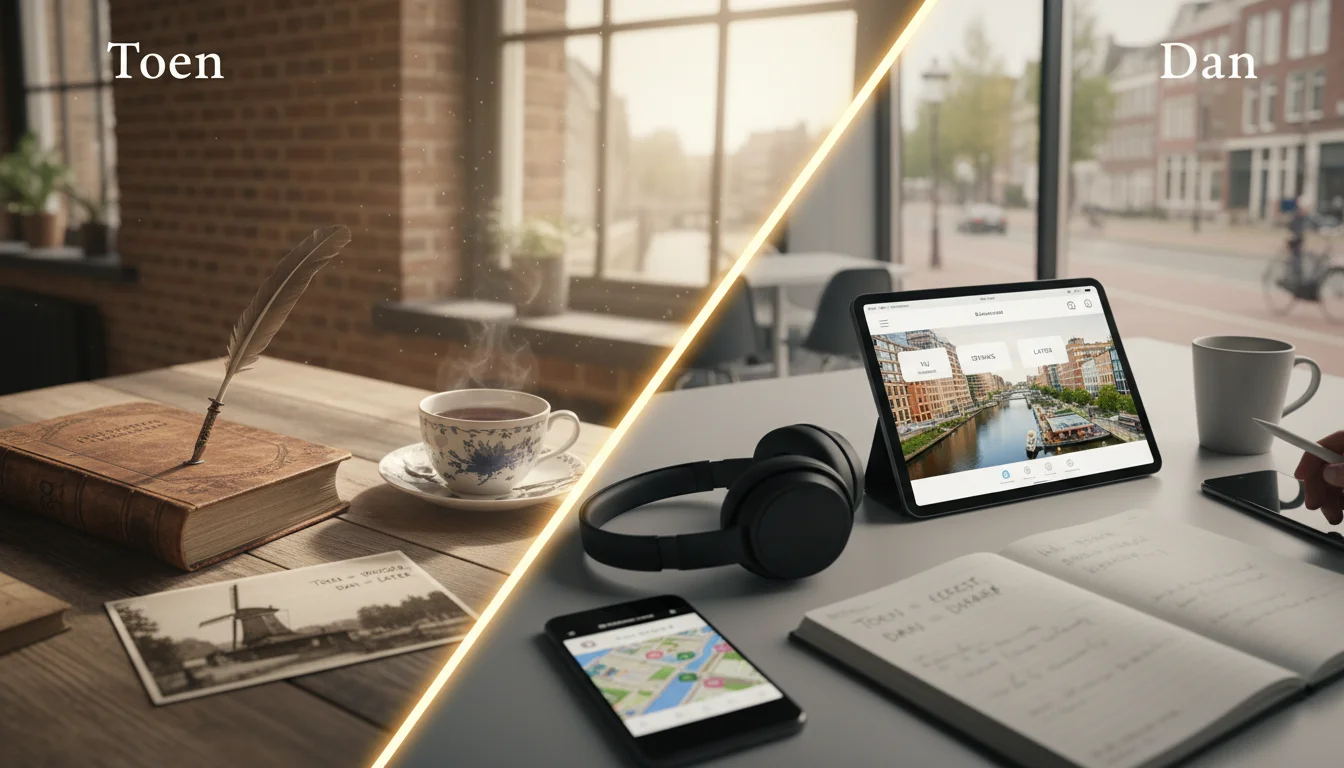
Getting this distinction right is crucial for being understood. Mispronouncing vowel length can lead to confusion because it's as fundamental as knowing the difference between 'toen' and 'dan' in conversation. Tools like StroopTaal’s AI-powered pronunciation training can be invaluable here, giving you instant feedback on your vowel length until it becomes second nature.

Common Short Vowel Traps

  • a (as in man): More open and further back than the 'a' in English "man."
  • e (as in bed): Very similar to English, but can be a bit shorter and sharper.
  • i (as in ik): Like the 'i' in "sit" or "bit."
  • o (as in pot): More rounded than the English 'o' in "pot." Purse your lips slightly.
  • u (as in bus): This is a tough one. It's similar to the schwa sound (the 'a' in "about"), but more deliberate. It's like the 'u' in "tuck" but with a more relaxed jaw.

Challenging Long Vowels

  • aa (as in maan): A long, open 'ah' sound, like at the doctor's office.
  • ee (as in zee): The pure 'ay' sound we discussed earlier.
  • ie (as in bier): Usually easy for English speakers; it's the 'ee' sound in "see."
  • oo (as in boot): The pure 'oh' sound.
  • uu (as in muur): Another uniquely Dutch sound. To make it, say the Dutch 'ie' sound (English 'ee') and, without moving your tongue, round your lips very tightly as if you're blowing out a candle. It's a high, front, rounded vowel. Practice with muur (wall), duur (expensive), and vuur (fire).

Dutch Pronunciation Guide: Quick Reference for Dutch Vowel Pronunciation

A reliable Dutch pronunciation guide groups sounds into short vowels, pure long vowels, and compound diphthongs to help you target your mouth shape accurately. When practicing Dutch vowels pronunciation, focus on tongue placement and lip rounding rather than relying on English approximations.

In the StroopTaal app, pronunciation practice scores a word or a sentence you say and tells you what to improve, making it easier to lock in tricky Dutch vowel pronunciation patterns through real-time feedback.

Actionable Tips for Perfecting Your Dutch Vowels

Knowing the theory is one thing, but putting it into practice is another. Here’s how you can actively improve your Dutch vowel pronunciation.

  1. Listen Actively: Immerse yourself in Dutch. Listen to podcasts like Echt Gebeurd, watch the news on NOS, or listen to Dutch music. Don't just hear the words; listen specifically for the vowel sounds we've discussed.
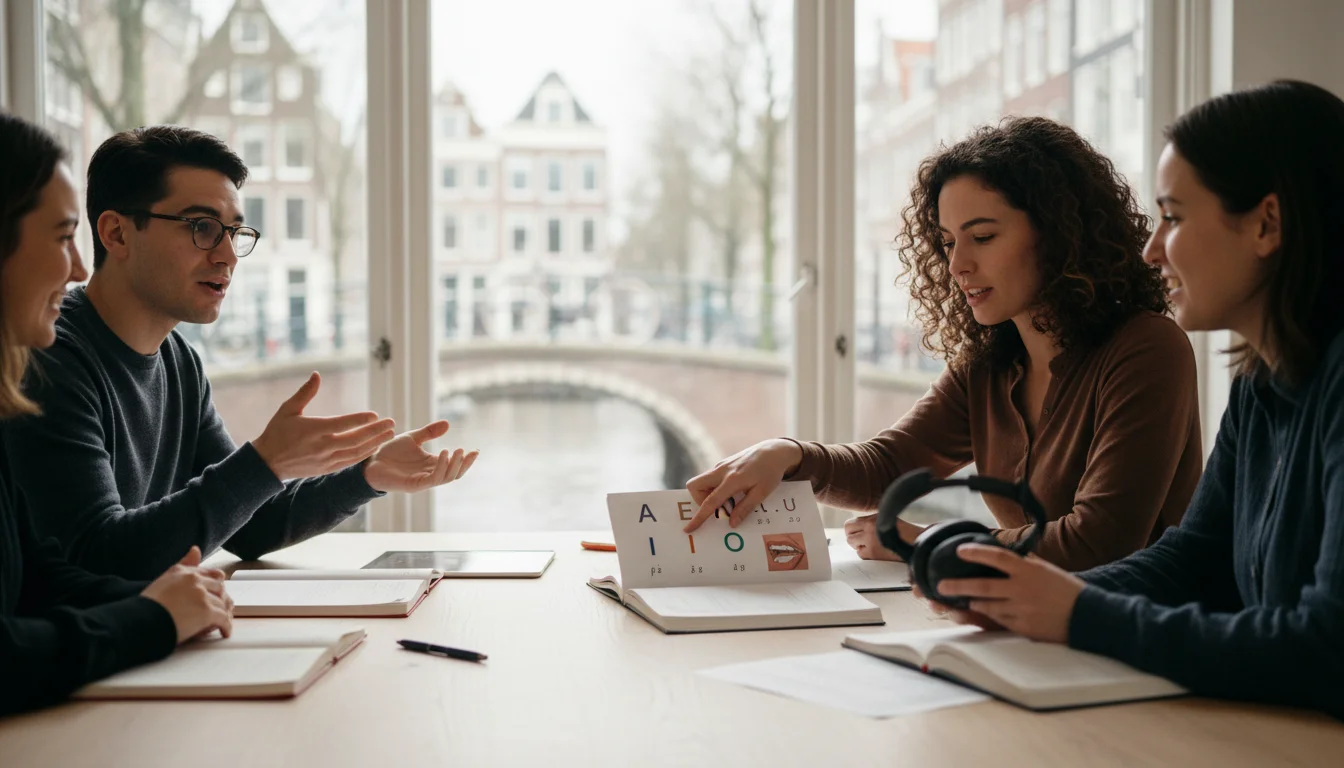
  2. Watch and Mimic: Watch Dutch YouTubers or TV shows. Pay close attention to their mouth shapes when they speak. Try to mimic the shapes yourself in a mirror. Understanding the physical mechanics is half the battle. For a deep dive into the technicals, the Wikipedia page on Dutch phonology is an excellent resource.
  3. Practice with Minimal Pairs: This is a powerful technique. Make a list of words that differ only by one vowel sound and practice saying them aloud. For example: tak (branch) vs. taak (task); zon (sun) vs. zoon (son); vis (fish) vs. vies (dirty).
  4. Record Yourself: Use your phone's voice recorder. Say a list of practice words, then listen to a native speaker say the same words (you can use online dictionaries like Forvo). Compare your pronunciation. It can be cringe-worthy at first, but it's one of the most effective ways to self-correct.
  5. Use AI-Powered Feedback: This is where technology can accelerate your learning. The StroopTaal app features real-life conversation practice with an AI tutor that understands your speech and provides instant pronunciation feedback. You can practice tricky words and common Dutch phrases for socializing in a stress-free environment, building muscle memory and confidence without the fear of making mistakes in front of a person.

From Vowel Anxiety to Pronunciation Pro

Mastering Dutch vowels is a journey, not a destination. It requires patience, active listening, and a willingness to make some strange sounds until they feel natural. By focusing on the key challenges—keeping your pure vowels pure, tackling the unique diphthongs like 'ui' and 'eu', and respecting the critical difference in vowel length—you can make dramatic improvements in your accent and comprehensibility.

Don't let vowel anxiety hold you back. Every time you practice, you're retraining your brain and your mouth to work in a new, Dutch way. Before you know it, you'll be ordering a biertje in a leuk cafe by the tuin without a second thought.

Ready to get instant feedback on your pronunciation and fast-track your learning? Download the StroopTaal app today and start practicing with our AI-powered tools designed to help you conquer Dutch vowels and speak with confidence!

Frequently Asked Questions

What is the hardest Dutch vowel sound for English speakers?
The 'ui' sound (as in 'huis') is often the most difficult, as it has no English equivalent. It requires a unique mouth movement, starting with a sound like the 'a' in 'cat' and then rounding the lips towards an 'oo' sound.
Why is vowel length so important in Dutch?
Vowel length is crucial because it can completely change the meaning of a word. For example, 'man' (man) has a short 'a', while 'maan' (moon) has a long 'aa'. Mastering this is key to being understood correctly.
Are 'ij' and 'ei' pronounced differently in Dutch?
No, 'ij' and 'ei' are pronounced exactly the same in modern Dutch. The sound is a diphthong similar to the English 'eye' but is more open, starting with a sound like 'ah' and gliding to 'ee'.
dutch vowels
Dutch vowels include five short vowels (a, e, i, o, u), four pure long vowels (aa, ee, oo, uu), and unique diphthongs such as ui, eu, and ij/ei. Unlike English vowels, Dutch pure vowels require a stationary tongue and jaw without gliding.
vowels in dutch
Vowels in Dutch change between short and long sounds depending on whether they sit in open or closed syllables. Dutch uses standard Latin vowel letters but combines them into distinct single and double-letter sounds that define word meanings.
dutch pronunciation
Dutch pronunciation relies heavily on pure monophthongs, crisp syllable boundaries, and consistent rules for vowel length. Mastering Dutch sounds requires holding mouth shapes steady for vowels and learning specific sounds like the guttural 'g' and diphthong 'ui'.
dutch vowels pronunciation
Dutch vowels pronunciation requires distinguishing short vowels in closed syllables from long vowels in open syllables or doubled spellings. English speakers must avoid adding diphthong glides to long pure vowels like 'ee' and 'oo'.
dutch pronunciation rules
Dutch pronunciation rules dictate that single vowels in open syllables are long, while single vowels in closed syllables are short. Doubling consonants preserves a short vowel, whereas single vowels at the end of syllables naturally lengthen.
dutch vowel sounds
Dutch vowel sounds consist of short vowels (like 'a' in man), pure long vowels (like 'aa' in maan and 'uu' in muur), and glided diphthongs (such as 'ui', 'eu', and 'ij'). Each sound requires specific lip rounding and tongue positioning.
dutch pronunciation guide
A practical Dutch pronunciation guide breaks sounds into short vowels, pure long vowels, and unique diphthongs. Practicing minimal pairs and focusing on mouth shape mechanics helps English speakers overcome common accent traps.